| |
| At the Congress of Vienna (June 9th, 1815)
Austria was confirmed in her possession of the cities of Milan and Venice
as before the Napoleonic era. Both cities were occupied by Austrian troops
following the French retreat after Waterloo. On April 7th, 1815 Milan and
Venice were unified under the Regno Lombardo Veneto with Milan as capital
town. The area was limited to old Milan Ducato and included towns of Mantova,
Cremona, Bergamo, Como, Sondrio, Pavia, Lodi and Cremona in Milan's sphere
of influence and the towns of Padova, Vicenza, Verona, Treviso, Udine, Rovigo
and Belluno in the Venice area. |
| In 1818 the Archduke of Austria Ranieri
of Ausburg Lorena (1783-1853), younger brother of Frances I was appointed
"Vicerè" (Regent). He married Maria Elisabetta di Savoia-Carignano
sister of Carlo Alberto di Savoia King of Italy from 1831 to 1849. Ranieri
ruled for more than 30 years up to 1848, assisted by two governors, first
in Milan and the other in Venice. |
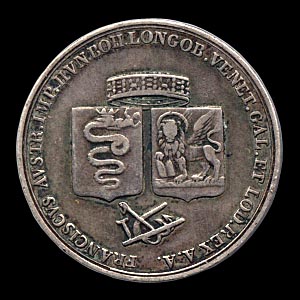
Following is an explanation of the obverse
legend:
(AVSTRIAE IMPERATOR HVNGARIE BOHEMIAE LOMBARDIAE VENETIAE GALICIAE ET LODOMERIAE
REX ARCHIDVX AVSTRIAE). Roughly, this means Franz; Austrian Emperor, Hungarian
Bohemian, Lombardy Venetian Archduke of Austria. There is the symbol of
Milan with the crowned snake eating a kid (from the Visconti family, early
12th century) on right and Venetian San Marco's winged lion holding an open
Gospels (meaning that the Serenissima Republic is peaceful). Above, the
Iron Crown of Italy (which has one of the Holy Nails of the Cross of Jesus
in it). In the field, an Anchor (Venice) and Plough (Milan). |
An explanation of the reverse legend:
FIDES NOVI REGNI // SACRAMENTO FIRMATA // MEDIOLANI XV.MAII // MDCCCXV.
Loyalty to the new Holy kingdom signed - Milan May 15th, 1815. |
| This token was struck to celebrate the
oath of allegiance of Lombardy towns part of Kingdom Lombardo-Veneto to
Frances I of Austria. During the celebration (May 15, 1815) several of these
tokens in silver and copper were thrown to people from the Archduke Giovanni
of Austria. |
| The engraver was the talented Luigi Manfredini.
Though referred to as a lira it was struck on an unusual size planchet.
This medal or token can be considered scarce. This information was provided
by an expert on Italian numismatics, Nicolò Pirera of Italy. |
| Thanks, Nicolò! |
| |
Bramsen - 2310
Retour de François Ier à Milan.
(Manfredini.) |
| Comme celui du No
1616. |
Rev: Dans le champ, sous la couronne
royale: FIDES NOVI REGNI SACRAMENTO FIRMATA MEDIOLANI XV. MAII MDCCCXV. |
| FRANCISCVS AVSTR. IMP. HVN. BOH. LONGOB. VENET. GAL.
ET LOD. REX A. A.; dans le champ: les écussons de Milan et
de Venice surmontés de la couronne de fer; dessous: des emblêms
de la paix. |
| Médaille, 23 mm. - Cabinet de l'auteur. |
|
Milan - 879
Francesco I d'Austria — Milano — Giuramento di sudditanza
delle Province Lombarde |
D. FRANCISCVS AVSTR. IMP. HVN. BOH. LONGOB. VENET.
GAL. ET LOD. REX A. A.
Nel centro, al centro, scudi affiancati, sormontati dalla corona ferrea,
a s.; di Milano, con biscia viscontea, ed a d., di Venezia con Leone
di San Marco; nel campo, in basso, al centro, aratro ed ancora intrecciati.
Contorno a piatto e gola. |
R. Nel campo, in alto, al centro, corona imperiale
ed in basso, in quattro righe: FIDES NOVI REGNI SACRAMENTO FIRMATA
MEDIOLANI XV. MAII MDCCCXV. Contorno a piatto e gola. |
| Autore: MANFREDINI(?); |
Data: 1815 |
| Caratteristiche tecniche: Argento; |
Ømm 22,6; 0; Coniazione |
| Condizione giuridica: Commune n.1715;
N. Inv.: M.0.9.27652 |
| Bibl.: Bramsen, n.2310; Julius, n. ---;
Essling, n. 1572; Millin, n. ---; De Félissent, n.---; Pagani,
n.512; Martini n.53 (questo esemplare) |
|