BHM #434 - 1797
Battle of Cape St. Vincent (D & H 64 - Hampshire, Portsmouth) |
|||||
 |
 |
||||
|
|
||||
| AE 29 by ? T. Wyon Sr. | AE C. | ||||
| D. & H. Hants. 65 & 65a; M.H. 744; S. Q/46. AM; BM; NMM. | |||||
| Edge: PORTSMOUTH HALFPENNY PAYABLE AT THOS SHARPS | |||||
| This piece was probably intended to be used as a token and some varieties have edge inscriptions indicating their use as such. |
| from British Historical Medals, Volume I, p. 103 |
| (D & H 65 - Hampshire, Portsmouth) | ||||||
 |
 |
|||||
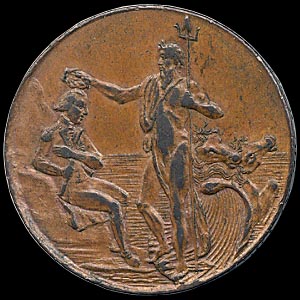
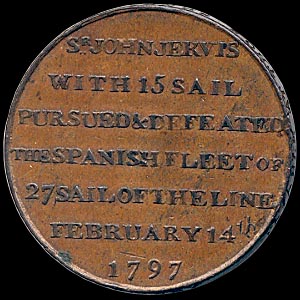
| More examples of this relatively common medal / token. These two are only slightly different, so subtle that only a picture will convince. | ||||||
|
||||||
| Bell - 81/82 ENGLAND / HAMPSHIRE / PORTSMOUTH No. 11 |
|
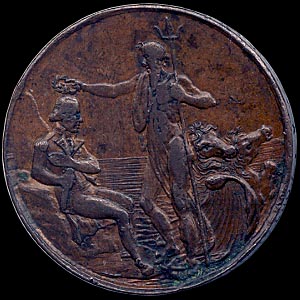
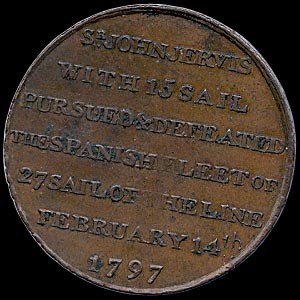
| Obverse: - Sir John Jervis in uniform and bare headed seated on a rock with his left arm folded across his chest, and holding a scroll in his right hand. Neptune steps from his car to crown the hero with a wreath of laurel, held in the right hand, while his left grasps a symbolical trident. The sea-horses drawing his chariot are behind and to the right. | Reverse: - An inscription in seven lines. SIR JOHN JERVIS WITH 15 SAIL PURSUED & DEFEATED THE SPANISH FLEET OF 27 SAIL OF THE LINE FEBRUARY 14TH 1797 |
| Edge: - PORTSMOUTH HALFPENNY PAYABLE AT THOS SHARPS .X. | |
| Struck in a collar. | |
| Diesinker, Wyon; manufacturer, Kempson. Five cwts. struck. Common | |
| Comments. The issuer was Thomas Sharp, a mercer, and also issuer of Hampshire No. 12. |
| from Commercial Coins, 1787-1804. pp. 55-56. |
| D & H 64 - Sir John Jervis | |
| O: | As last. |
| R: | Similar to last, the 2 of 27 is under second limb of H. |
| E: | As No. 61. |
| D & H 65 - Sir John Jervis | |
| O: | Similar, the bottom edge of the officer's coat being straight, and there is more water shown at the bottom. |
| R: and E: | As last. |