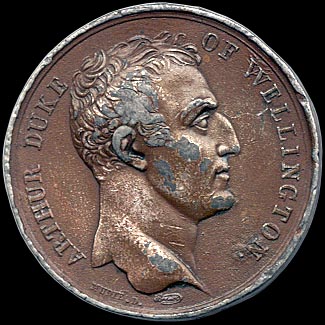
Mudie - XII.
ARRIVAL OF THE ENGLISH ARMY IN THE PENINSULA. |
| The illustrious General, who forms the subject of this Medal,
was born May 1, 1769, being the fifth son of the late Earl of Mornington.
The family from which he is descended (that of Cowley or Colley)
was of English origin, and settled in the county of Rutland. In
the reign of Henry VIII. it migrated to Ireland, and that country
has to boast of having given birth to the greatest warrior of modern
times. The seat of his ancestors (Dengan Castle) was the place
of his nativity, but, when he attained a sufficient age, he was
sent to Eton. An early and decided predilection for a military
life occasioned his removal from that celebrated seminary before
he had time to acquire those scholastic advantages which a longer
abode there would have secured. From Eton he went to Angers in
France, and in the military academy of that town he prosecuted
studies, which, were congenial to his nature. On the 25th December
1787, being then in his eighteenth year, Mr. Wellesley received
an ensign's commission in the 41st regiment. |
| England was then enjoying a profound peace,
and Ensign Wellesley had no immediate prospect of gratifying his
wishes by signalizing himself in active service. Meanwhile, however,
he continued to rise in rank. On the 23d January 1788 he obtained
a lieutenancy; and on the 30th June 1791 he was appointed Captain
in the 58th or Rutlandshire regiment. On the 30th April 1793 be
received a majority in the 33d regiment; and on the 30th September,
in the same year, he purchased a lieutenant-colonelcy in it. |
| The year 1794 may be regarded as the commencement
of that career whose glorious progress and termination will form
a bright page in the annals of England. Lieutenant-colonel Wellesley
was with his regiment in the expedition under Lord Moira, which-landed
on the coast of Britanny. The troops composing this expedition
were subsequently compelled to hasten to the relief of the Duke
of York in the Netherlands, and Lieutenant-colonel Wellesley, at
the head of three battalions, covered all the movements of the
army during the disastrous retreat that followed. It is said that
on this occasion he displayed a degree of coolness and skill which
excited the highest admiration among those officers who witnessed
his conduct. |
| In 1797 the Earl of Mornington (now Marquis
Wellesley) was nominated Governor General of India, and his brother,
Colonel Wellesley, went out to that country with his regiment (the
33d) in the same year. We cannot enter into the details of his
military achievements in the East, which could have been surpassed
only by his own more renowned exploits afterwards in Europe. At
the memorable siege of Seringapatam he signally distinguished himself
as far as any opportunity for doing so was afforded him; and he
was subsequently appointed to the command of that city, when it
passed, with the other dominions of Tippoo, into our possession. “The
command of Seringapatam,” observed Lord Mornington, in one
of his dispatches to the Court of Directors, “will remain
in the hands of Colonel Wellesley. It is a trust of great delicacy
and importance, which it is my duty to repose in a person of approved
military talents and integrity.” On the 25th July 1801 he
was gazetted as brigadier-general of the English army in Egypt,
though, in point of fact, he never joined the troops under the
command of Sir Ralph Abercromby. |
| It was in India that this great commander gained
his first victory, and displayed those consummate talents in the
field which afterwards raised him to so proud a height of glory.
The battle of Assye, which was fought on the 24th Sept. 1802, exhibited
all those peculiar features which, expanded upon a wider theatre,
and dignified by a mightier stake, have filled Europe with his
renown. It was distinguished by three circumstances, all of them
component parts of his subsequent achievements, viz. the promptitude
with which be changed his proposed mode of attack, even though
in actual march to execute it; his determination to engage with
an inferior force, rather than by waiting for his own troops to
arrive, also give time for the enemy to receive reinforcements;
and lastly, the ready abandonment of his cannon, when he found
that the difficulty of advancing it checked the more valuable rapidity
of his movements. This victory was no less decisive in its consequences,
than brilliant in its character, for it led to the pacification
of India. The thanks of both Houses of Parliament were bestowed
upon him, May 3, 1804, and he was elected a Knight Companion of
the most honourable Order of the Bath. |
| In March 1805 he returned to England, and in
1806 took his seat in Parliament as Member for Newport in Hampshire.
In the same year, on the 10th April, he was married to the present
Duchess of Wellington. This lady was the Hon. Catherine Packenham,
third daughter of Edward Lord Longford. |
| In 1807 Sir Arthur Wellesley was appointed
Chief Secretary of Ireland, during the viceroyalty of the Duke
of Richmond, and in the same year he accepted a command under Lord
Cathcart in the expedition which was fitted out against Copenhagen.
On this occasion also he eminently distinguished himself; and again
received the thanks of the House of Commons as one of the officers
who were employed on that memorable service. |
| The following year (1808) saw him land upon
the coast of Portugal at the head of a small army which was intended
merely to assist the Portuguese in throwing off the detestable
yoke of France. How little did Napoleon, how little did Europe,
how little did England herself think, at that moment, what a rich
harvest of glory he was destined to reap. The rest of his biography
is written in the annals of his country, and commemorated in our
medallic series. The separate description which we have to give
of his principal victories, will form the noblest history of his
life. From the lines of Torres Vedras he marched step by step,
in the track of victory, dispersing the hostile legions that opposed
him, baffling the skill of the ablest generals in Europe, and beating
them by the superior energies of his comprehensive mind, not by
the decisive superiority of numbers. He turned the arms of the
oppressors on themselves. The invaders became the invaded: the
conquerors were the conquered: the imperial eagle, dabbled with
blood, and checked in her towering flight, fled in terror before
him. He entered the Peninsula, and saw it, in dreary prospect before
him, bowed down in its captivity; he left it, and looking behind
him from the lofty summit of its Pyrenean frontiers, beheld it
smiling and grateful, freed from an odious bondage, standing erect
again, and breathing the free air of liberty. “The military
triumphs,” to use the energetic language of the late Speaker
of the House of Commons (now Lord Colchester), “which his
valour achieved on the banks of the Douro and the Tagus, of the
Ebro and the Garonne, called forth the spontaneous shouts of admiring
nations.” This eulogy was pronounced before the battle of
Waterloo. In what terms of wonder and delight could the same accomplished
orator have conveyed the feelings of England and of Europe at that
stupendous triumph ? |
|
| DESCRIPTION OF THE MEDAL. |
| Obverse. - Head of the Duke, in imitation of the antique;
inscription, “ARTHUR DUKE OF WELLINGTON.” |
| Reverse. - An allegorical display of the arrival of
the British army in the Peninsula, to assist it against the French,
whose military power and success in that country are pourtrayed by
the eagle with the fulmen or thunder-bolt pursuing the armed force
of Spain and Portugal, who are personated by two females imploring
British aid. Round the face of the Medal is inscribed, “THE ENGLISH
ARMY ARRIVES IN THE PENINSULA.” On the exergue, or small division
of the Medal, parted off from the subject, is the date of the arrival.
In the back ground are the mountains peculiar to the country, which
are also represented by the pillars of Hercules, the ancient emblems
of the Peninsula. |
|