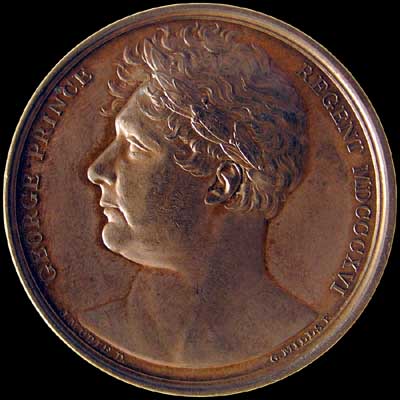
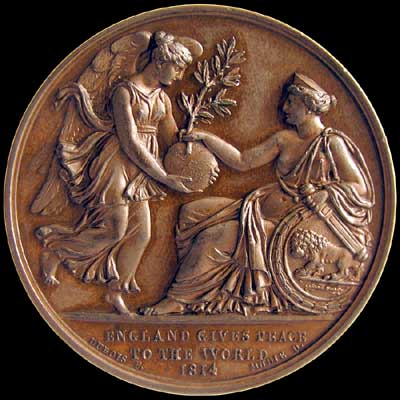
| THE inscription on the exergue of this Medal expresses an historical fact, which will dignify the character of England to the latest posterity. She did, indeed, "give peace to the world." It was her undaunted perseverance, her noble struggle, single-handed, with the mighty despotism of imperial France; her unparalleled sacrifices of blood and treasure; her proud, untameable defiance of the Gallic eagle, which, finally achieved the peace of Europe. |
| Let it not be forgotten, however, that in the glory of the triumph, the Sovereign claims his share. Had his councils been less decisive, had his purpose been less fixed, had there been a particle of weakness, or hesitation in the royal mind, the country could not have signalized itself in the way it did. The REGENT, administering his high office, in trust for his venerable sire, anxiously endeavoured to tread in that path which he knew his father would have trodden, had he been permitted by Providence to direct the march of public events. Hence the unbending hostility which this country displayed towards the arrogant pretensions and insulting aggressions of Napoleon. Hence, too the justice of that acknowledgment on the part of Louis XVIII who, when he made his triumphal entry into London, after his recall to the French throne, observed to the Regent, “It is to your Royal Highness's councils, to this great country, and to the constancy of its people, that I shall always ascribe, under Providence, the restoration of our house to the throne of our ancestors." No one will deny this declaration; no one will deny, that the subversion of Napoleon's power, and the opportunity for the Bourbons to re-ascend the throne, were the results of that unshaken perseverance on the part of England, which no peril, no sacrifice, no temptation could relax or overcome. This intrepid example not only taught other nations how they might save themselves, but presented a bulwark and defence round which they might rally in the common cause whenever they had spirit and patriotism enough to rouse from their lethargy. Most emphatically, therefore, and most truly, may it be said, that "ENGLAND GAVE PEACE TO THE WORLD." |
|