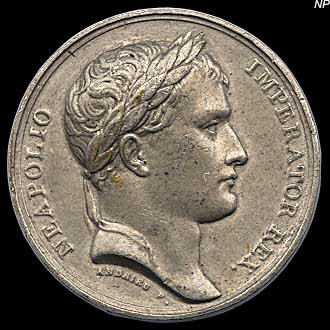
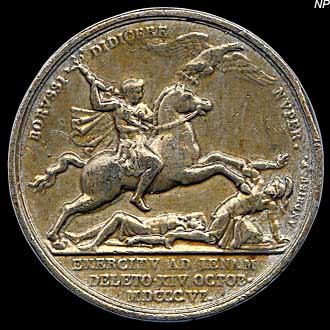
| These two medals were struck, under the inspection,
and by the order of the government of France, to commemorate the battle
of Jena. The night preceding this great event, presented a remarkable spectacle:
two great armies, one of which extended its front upon a line or six hours
march, and illuminated the air with its lights; the other appeared more
condensed, the lights of which seemed to be brought nearly into one point;
in both all was watchfulness and motion. The lights of the two armies were
at half cannon shot distance only; their centinels almost met; "and
not a single motion on either aide, but what could be perfectly heard by
the other. |
| A thick fog obscured the morning. Napoleon, passing
before the different lines, commanded the soldiers to take care of the Prussian
cavalry, which was reputed the best in the world; and stated "that
the Prussians at that moment did not fight for glory, but for a retreat,
and that the corps of the French army which should let them pass, would
lose its honour;" he also reminded them that a year had not elapsed
since Ulm was taken; that the Prussian army, now before them, like the Austrians
at that period, was surrounded, had been driven from its line of operations,
and had lost its magazines. To this military harangue, the soldiers replied
"let us onward." |
| The Prussian army, in the mean while, had no other view
than to engage as soon as the fog should clear up. A body of 50,000 men
posted itself, to cover the defiles of Naumburg, and to gain possession
of the passes of Koesen; but the design of this movement was frustrated
by Marshal Davoust. The rest of the Prussian force, consisting of about
80,000 strong, was placed opposite to the army of the French, which was
opening out from the level height of Jena. The fog continued for the space
of two hours, but at last cleared up; and the hostile armies beheld each
other at a distance less than cannon shot. The left wing of the French supporting
itself against a village, and a wood was commanded by Marshal Augereau.
The imperial guard opened its fire at the centre, which was supported by
Marshal Lasnes: the right wing was drawn together out of the corps of Marshal
Soult, who had left only a small body of 2,000 men, partly composed of troops
which had arrived from his light corps. |
| The Prussian army, which seems to have consisted of
about 130,000 men, displayed a fine cavalry, and fought with great bravery.
The King of Prussia had two horses shot under him. Their maneuvers were
correctly and rapidly executed; but they were at last thrown into dreadful
confusion. The French dragoons and cuirassiers, with the Duke of Berg at
their head, bore the Prussian cavalry and infantry down before them. In
vain did the Prussians form themselves into a square; five of their battalions,
cavalry, infantry, and artillery, were all taken. On the right wing, Marshal
Davoust was completely successful, constantly fighting for the space of
three hours; he pursued the great body of the Prussians from the defiles
of Koesen. The battle was sanguinary in the extreme, 250,000 or probably
300,000 men, of which the two armies were composed, with 700 or 800 pieces
of artillery, scattered death in every direction, and exhibited one of the
most awful scenes recorded in history. The result was the most decisive
in favour of the French that could be imagined; the loss of the Prussians,
according to the bulletins of the French, was above 20,000 killed and wounded,
and from 30,000 to 40,000 prisoners, with 300 pieces of cannon, sixty standards,
and immense magazines of warlike stores and provisions. |
| The Duke of Brunswick was mortally wounded, and expired
a few days afterwards at Altena; above twenty of the Prussian generals were
taken prisoners. |
| Though suspicions may attach to this French account
of the Battle of Jena, the disastrous and extraordinary consequences of
this memorable action were such as to render exaggeration unnecessary, and
almost impossible; the rapid successes of the French, and the accumulated
misfortunes of the Prussians, are without precedent in military history.
The Emperor of the French immediately took possession of Potsdam and Berlin,
where he levied vast contributions. |
| |
| Edwards - 200 |
| Plate XIV. No. 8 |
14th October, 1806. |
Medal. |
|
| Neapolio imperator rex. |
| R. Borussi didicere nuper. |
Exercitu ad Jenam deleto. |
Napoleon on horseback. |
|
| NEAPOLIO IMPERATOR REX. (Napoleon, Emperor and King.)
Laureated head, to the right, as that of No. 4 Plate V. Beneath: ANDRIEU
F. (fecit). |
| R. BORVSSI DIDICERE NVPER . (The
Prussians learnt but lately to know him.) Napoleon on horseback, in
antique robes, armed with a thunderbolt, and preceded by an eagle, gallops
over the bodies of two prostrate enemies. Exergue: EXERCITV AD JENAM DELETO
. XIV . OCTOB . (Octobris) MDCCCVI. (Army destroyed at Jena, the
14th October 1806) Above the exergue, to the right, circularwise:
ANDRIEV F. (fecit). [40"] |
| Paris Medal Mint. |
Bramsen - 537
Bataille d'Jena. (Andrieu.) |
| NEAPOLIO IMPERATOR REX. Buste lauré, à
droite. |
Rev: BORVSSI DIDICERE NVPER. Napoléon en général
romain, lauré, brandissant un foudre et précédé
d'un aigle, passe au galop de son cheval sur le corps de deux ennemis. |
| Exergue: EXERCITV AD JENAM DELETO . XIV . OCTOB . MDCCCVI. |
| Médaille, 41 mm. - T. N. 14, 8; H. m.
40, 203; M. F. 363, 60 bis. |
Milan - 542
Napoleone — Battaglia di Iena |
D. NEAPOLIO IMPERATOR REX.
Nel centro, testa laureata di Napoleone a d.; nel campo, in basso, al centro,
a s., sotto il taglio del collo: ANDRIEU F.
Contorno a piatto e gola. |
R. BORVSSI DIDICERE NVPER.
Nel campo, a s., Napoleone in abiti classici, a cavallo impennato a d.,
in atto di calpestare soldato nemico a terra, regge con la mano d. sollevata,
fulmini e con la s., redini; in alto, a d., aquila volante a d.; in basso,
al centro, soldato a terra; in basso, a d.: ANDREIU F. All'esergo: EXERCITV
AD IENAM / DELETO . XIV . OCTOB . / MDCCCVI. Contorno a piatto e gola. |
| Autore: ANDRIEU; |
Data: 1806 |
| Caratteristiche tecniche: Argento; |
Ømm 40,5; 0; Coniazione |
| Condizione giuridica: Stato-Brera n.219;
N. Inv.: M.0.9.30399 |
| Bibl.: Bramsen, n.537; Julius, n. 1594; Essling,
n. 1141; Millin, n. 203; De Félissent, n.367 |