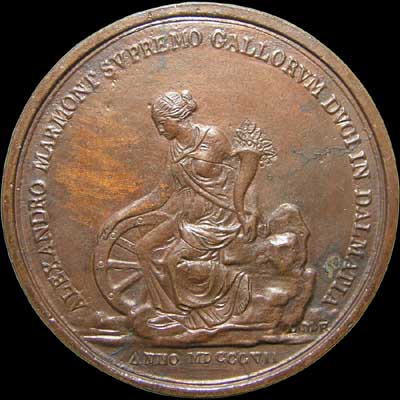
| R: ALEXANDRO MARMONT SVPREMO GALLORVM DVCI IN DALMATIA. (To
Alexander Marmont, General-in-chief of the French troops in Dalmatia).
Dalmatia, seated on a rock, leaning with her right hand upon a wheel, and with
the left upon a horn of plenty: ANNO MDCCCVII (year 1807). Above
the exergue, to the right: L.M.F. (Luigi [Lewis] Manfredini,
fecit). [42".] |
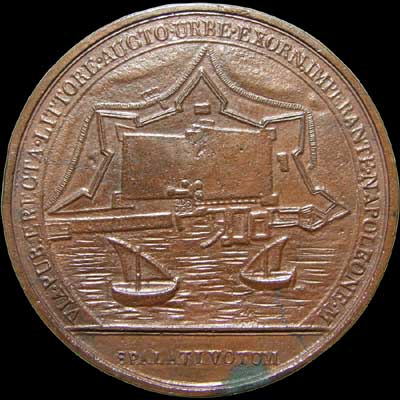
This medal was struck in honour of General
Marmont by the inhabitants of Spalatro in Dalmatia.
AUGUSTUS-FREDERICK LEWIS VIESSE DE MARMONT was
born at Chatillon-sur-Seine, July 20th, 1774, and in 1789 entered a regiment
of
infantry as sub-lieutenant, whence, in 1792, he passed with the same rank
into the artillery. Attached to the army of Italy in 1796 as major, and
as first aide-de-camp to General Bonaparte, he went through the campaigns
of Italy and Egypt. His participation in the revolution of the 18th Brumaire
obtained for him the functions of Counsellor of State and the chief command
of the artillery of the army of reserve. After the campaign of Marengo
he was made general of division, and in 1801 first inspector-general of
the artillery. In 1807 the command of the army in Dalmatia having been
confided in him, he remained in that province until the campaign of 1809,
and was actively employed in the internal administration of the country.
The title of Duke of Ragusa rewarded his services. After the battle of
Wagram he was charged with the pursuit of the enemy, whom he overtook at
Znaïm, and was made a marshal of the empire on the field of battle.
He remained in the Illyrian provinces as Governor-general until 1811, in
the May of which year he replaced Massena in command of the army of Portugal.
In 1813 and 1814 he served in the campaigns of Germany and France. Marmont
was one of the two marshals who signed the capitulation of Paris, and immediately
after he concluded a treaty with the allied sovrans, in virtue of which
his army was to quit the position which the emperor had ordered it to occupy
at Essone, and to retire by way of Versailles to a point beyond the line
of hostilities. This convention led to the immediate downfall of the Imperial
Government. Under the first Restoration the Duke of Ragusa was made captain
of the body Guards. In March 1815 he accompanied Louis XVIII. to Ghent,
and having returned to the Chamber of Peers after the hundred days, he
was from that period down to the Revolution of July one of the four marshals
commanding the Royal Guard, and was serving in that capacity when the ordonnances
of July 25, 1830, were issued. His presence at the head of the troops,
recalling the recollections of 1814, by no means contributed to calm the
popular irritation. Having then left France, he has not returned thither,
but has resided alternately in Germany and in Italy. |