Great Britain - 1791
½ Penny Token(D & H 2 - Lanarkshire, Glasgow) |
|||||||||||
 |
 |
||||||||||
|
|
||||||||||
| Edge:- PAYABLE AT THE HOUSE OF GILBERT SHEARER & CO. | |||||||||||
| Diesinker, Dröz; manufacturer, Boulton. Several tons were struck. Common. There are several counterfeits, and also a series of mules. | |||||||||||
| Comments. Nothing is known of Gilbert Shearer and Co. |
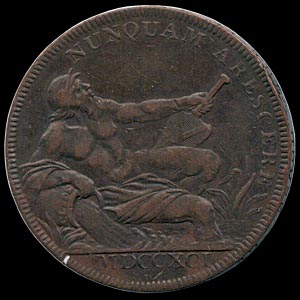
| This is one of the most beautiful tokens of the whole eighteenth century series. The reverse refers to the river Clyde which rises in the southern part of Lanarkshire, near Queensbury Hill, and after a course of seventy miles forms the arm of the sea known as the Firth of Clyde. |
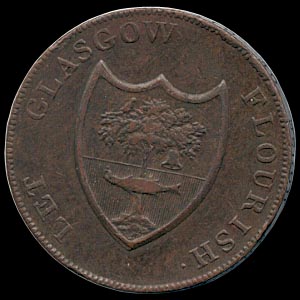
| Glasgow is the second city of Scotland, and said to have been founded by St. Kentigern in the sixth century. The city was made a free burgh in A.D. 1175 by William the Lion of Scotland. The Arms are unusual, and have been explained as follows : |
| St. Kentigern founded a small religious establishment on the banks of a tributary of the Clyde where the city now stands, and he hung a bell on a tree near his cell to summon worshippers to prayer. |
| There is a legend that a neighbouring queen carried on an intrigue with a soldier, and presented him with a ring her husband had given her. He accidentally dropped it into the Clyde where it was swallowed by a fish. Later the king asked for his ring, and the unfortunate queen sought St. Kentigern's aid. He opened a freshly caught fish and handed the ring back to the queen, whose honour and life were thus made safe. In some accounts of the story the ring was seized by a bird; who then dropped it into the river, and this is used to explain its presence on the coat of arms. |
| The complete motto of the city is "Let Glasgow Flourish through the preaching of Thy Word." |
| Commercial Coins 1787-1804., pp. 258-259 |
| D & H 2 - Let Glasgow Flourish | ||
| O: | The arms of Glasgow. LET GLASGOW FLOURISH. | |
| R: | A river god reclining on an urn, inscribed CLYDE, from which water is issuing. NUNQUAM ARESCERE. Ex: MDCCXCI. The initials R. D. under. | |
| E: |
|
|
| Also struck in silver and brass. | ||