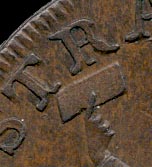
½ Penny Token (D
& H 46 - Yorkshire, Leeds) |
 |
 |
| Obverse - |
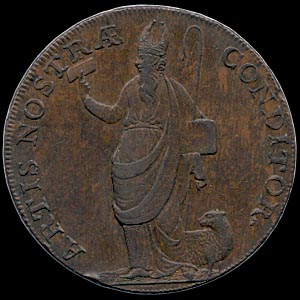
A full-length mitred figure of Bishop Blaze bearing
a crozier, with a book under his left arm and a scraper in his right.
A lamb is shown at his left side. |
| Legend: |
ARTIS NOSTRAE CONDITOR. |
|
| Reverse - |
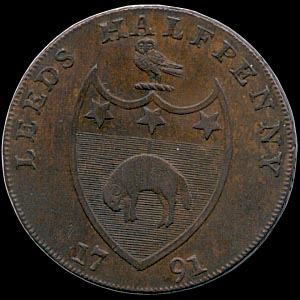
Arms of the town of Leeds. (Azure, a fleece or, on
a chief sable [improperly shown on the token as argent], three mullets
argent) and a Crest: (an owl). |
| Legend: |
LEEDS HALFPENNY 1791 |
|
| Edge:- PAYABLE AT THE WAREHOUSE OF RICHARD PALEY
.xx. |
| Diesinker, Hancock; manufacturer, Hancock. Five
tons struck. Common. A fine bold piece. There are several trifling varieties,
and nearly all are common. |
| |
| Comments. Richard Paley was a freeholder, maltster, soap-boiler,
and chandler with a business in a locality known as the "Calls" in Leeds.
He was also a member of the Common Council of the town. |
| |
| The reverse displays the arms of the town of Leeds,
but the diesinker, by one of the frequent mistakes in engraving heraldic
devices on these tokens, has literally rendered Black White. |
| |
| Leeds is supposed to have derived its name from a British
chieftain Lede, or Leod; and was incorporated by Charles II. The chief,
with the three mullets, was added to the arms of the town as a compliment
to the first Mayor, Thomas Dan by, who bore on a chief Sable, three
mullets argent. The armorial bearings of Leeds are completed by Supporters,
two owls, crowned with crest coronets. These are in compliment to Sir John
Savile, the alderman who obtained the charter of incorporation for the town. |
| Commercial Coins 1787-1804., pp. 206-207 |