| |
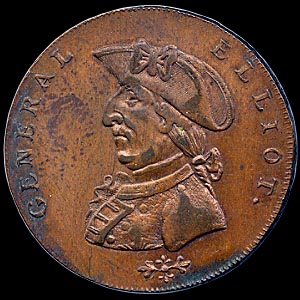
| Comments. Henry Biggs was a licensed victualler in Moore Street,
Birmingham; and his tavern may have been named the "General Eliott " or
the "Dr. Johnson's Head." |
| |
| General George Augustus Eliott was the commander of
the successful defence of Gibraltar in a siege lasting three years seven
months and twelve days, which began on June 21st, 1779; when the Spanish
cut off the land approaches and built assault batteries. Elliott was honoured
by being created Lord Heathfield. |
| |
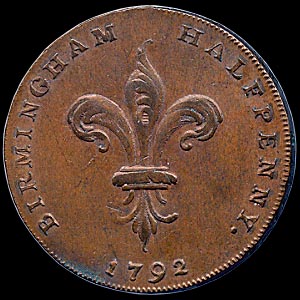
| The fleur-de-lys was the Royal Ensign of France as early
as the twelfth century, and Edmund, the first Earl of Lancaster, on his
marriage with Blanche of Artois, differenced his shield of the Royal Arms
of England with a label of France, charged with fleurs-de-lys; while Edward
III placed a fleur-de-lys on either side of the shield of the Arms of England
on his Great Seal and later quartered the Arms of France with those of England;
and thus the device figured in the heraldic bearings of both countries,
and was still part of the Arms of England when the token was struck. |
| |
| The fleur-de-lys is also used as a "mark of cadency"
to distinguish different branches of the same family. It is not clear why
it was used on this token. |
| |
| There is a token with a similar obverse but bearing
the cypher P S (Peter Skidmore) on the reverse, which was made for sale
to collectors. |
| Commercial Coins 1787-1804., pp. 192-193 |