Great Britain - 1792

½ Penny Token

(D & H 10 - Shropshire, Coalbrook Dale)
Obverse - Great Britain  - 1792 Reverse - Great Britain - 1792
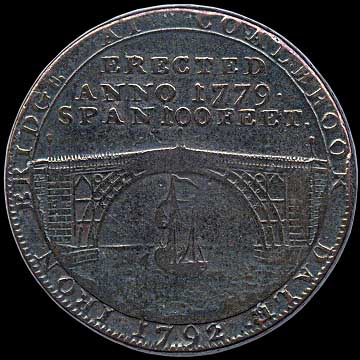
Obverse - View of an iron bridge over a river with a trow passing beneath. Inscribed above the bridge, ERECTED ANNO 1779. SPAN 100 FEET.
Legend: IRON BRIDGE AT COALBROOK DALE. 1792
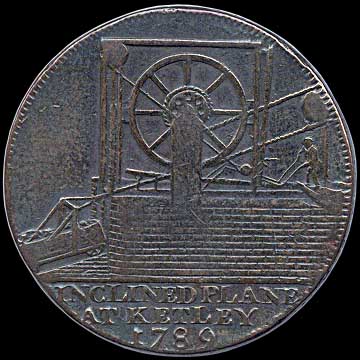
Reverse - View of an inclined plane with a man lowering a laden barge by the machinery
Exergue: INCLINED PLANE AT KETLEY.
1789 in the exergue.
Edge:- PAYABLE AT COALBROOK-DALE AND KETLEY +
Diesinker, Wyon; manufacturer, Kempson. Three tons struck. Common. There are several varieties of this token described in Dalton & Hamer's work but most are rare artist's proofs. They may be classified as:
(1) No information about the bridge on the obverse. D&H 3, 4.
(2) The height given. height 50 ft. D&H 6, 7.
(3) Trivial die variations. D&H 9-16.
 
Comments. The issuers were Messrs. Reynolds and Co., trading as the Coalbrook-Dale Iron Company, with establishments at Coalbrook-Dale and Ketley. The tokens were made payable in both places. The issuers cast the bridge shown on the obverse, which was the first iron bridge ever built, and spanned the Severn at the hamlet of Coalbrook-dale, near Brosley in Shropshire. It weighed two hundred and seventy-eight tons.
 
   The inclined plane represented on the reverse was on the private Ketley Canal at Ketley Lock. The canal linked the ironworks with the Shropshire Canal at a place called Oakengates, and the peculiar terrain prevented the collection of enough water for a stair of locks. Mr. William Reynolds invented the inclined plane by which a laden boat passing down pulled an empty one up to take its place. The plane achieved a lift of sixty-six feet.
Commercial Coins 1787-1804., pp. 142-143
D & H 10 - Coalbrook Dale
O: As last.
R:
 
Similar, the 9 is under last limb of L, and 1 under centre of K.