½ Penny Token (D
& H 33 - Lancashire, Lancaster) |
 |
 |
| Obverse - |
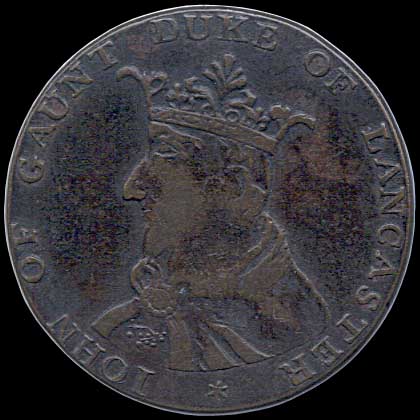
Bust of John of Gaunt in robes and ducal coronet. |
| Legend - |
IOHN OF GAUNT DUKE OF LANCASTER with a small star as
a stop. |
|
| Reverse - |
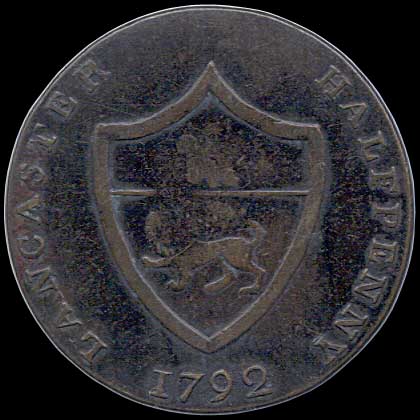
Arms of the Borough of Lancaster. (Gules, a lion passant
guardant or; on a chief azure, a fleur-de-lys of the second.) The
chief on the token is improperly argent, also the lion and fleur-de-lys. |
| Legend: |
LANCASTER HALFPENNY 1791 (1792) |
|
| Edge: PAYABLE AT THE WAREHOUSE OF THOS. WORSWICK
& SONS . X . |
| Diesinker, Hancock; manufacturer, Hancock. There
is a similar token but dated 1792. In all five tons appear to have been
struck. Common. |
| |
| Comments. Messrs. Worswick and Sons appear to have been gold and
silver smiths, watchmakers and jewellers in New-street, Lancaster. They
were also bankers, and the banking firm of Worswick and Sons was established
in 1794 by Thomas Worswick; he died in 1804 aged 74. His son Alexander died
in 1814 aged 50; and his second son Richard died in 1819 aged 51. The bank
was then conducted by Thomas Worswick, Jun. and his cousin Alexander Andrade.
The bank stopped payment on February 13th, 1822. |
| This firm had commercial interests in the West Indies,
and this may account for the tokens being payable at the warehouse. |
| There are about 19 genuine dies for these tokens, and
as many again of forgeries and imitations, notably some dated 1794. There
are also 7 mules. |
| John of Ghent, or Gaunt, was the fourth son of Edward
III, and born at Ghent about 1340. In the 36th year of this king's reign
we find that he:- |
| "in full Parliament did gird his son John
with a sword and set on his head a cap of furre, and upon the same
a circle of gold and pearls, and named him Duke of Lancaster, and
thereof gave to him and to his heires males of his body, and delivered
him a charter." |
|
| |
| In the 50th year of the same reign the king erected Lancaster into a county
palatine. |
| John of Gaunt also held the titles of Earl of Leicester, Lincoln,
and Derby, and was the High Steward of England. His son by his first wife,
Blanche, became Henry V. |
| Commercial Coins 1787-1804., pp. 83-85 |