½ Penny Token (D
& H 145 - Lancashire, Rochdale) |
 |
 |
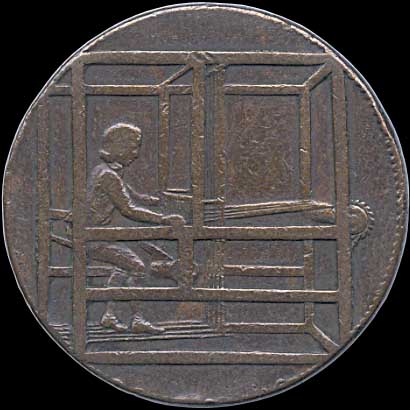
| Obverse :- |
Side view of a weaver at work in his loom. |
|
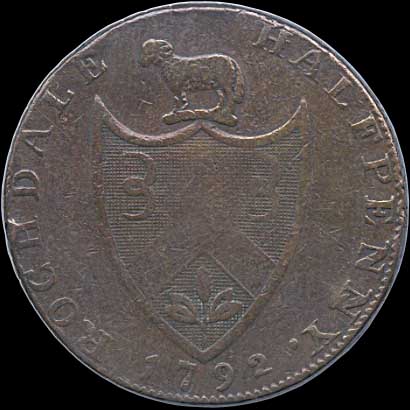
| Reverse :- |
Arms: (Sable, a chevron ermine, between two habicks
in chief argent; and a teasel, in base, slipped or), and Crest: (On
a wreath a mount vert [omitted on the token], thereon a ram statant,
or), of the Clothworkers' Company. |
| Legend :- |
ROCHDALE HALFPENNY .1792 |
|
| Edge:- PAYABLE AT THE WAREHOUSE OF JOHN KERSHAW |
| Diesinker, Wyon; manufacturer, Kempson. A fine
token, apart from the omission of the crest. Massive. One ton struck. Common. |
| Size, 29 mm. |
| |
| Comments. The arts of dressing flax and wool were known in Britain
before the arrival of Caesar, though according to him the islanders did
not weave. An Imperial manufactory was later established at Winchester
for making woollen and linen cloth for the Roman Army in Britain. |
| |
| The reverse shows the Arms of the Clothworkers' Company
who were incorporated by letters patent in 1482 under the style of "The
Fraternity of the Assumption of the Blessed Virgin of the Sheermen of London" (cloth-sheermen
sheered worsteds, stamins, fustians and other woollen cloths, and must
not be confused with sheep-shearers). The letters patent were confirmed
by Henry VIII. They were incorporated under the name of the Clothworkers
by Queen Elizabeth I, and confirmed by Charles I in 1634. The Arms were
granted by Henry VIII, and the Crest and Supporters by Elizabeth, at the
visitation of London in 1645. |
| |
| The teasel was used for gigging, or raising the surface
of the cloth, and the habick was used in dressing it. |
| |
| Rochdale is chiefly in the hundred of Salford in the
southern division of Lancashire, but it is partly in the Wapentake (or
hundred) of Agbrigg, in the West Riding of Yorkshire, though the civil
parish is wholly in the former county. |
| |
| J. Westwood, Jun. issued "half-halfpennies" of
this token, dated 1791, 1792 (D&H 156-7). |
| Commercial Coins 1787-1804., pp. 90-91 |