½ Penny Token (D
& H 47b - Lothian; Edinburgh; Counterfeits) |
 |
 |
| Obverse - |
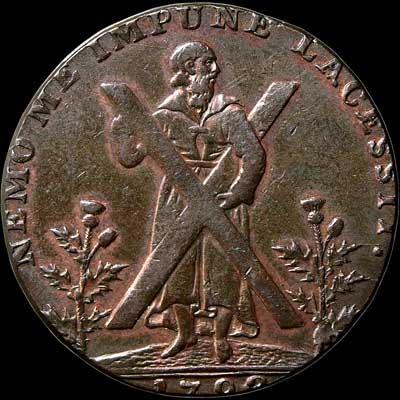
A full-length figure of St. Andrew, wearing a gown and carrying .his cross before him. At either side is a large thistle. |
| Legend: |
NEMO ME IMPUNE LACESSIT. with 1790 in the exergue. |
|
| Reverse - |
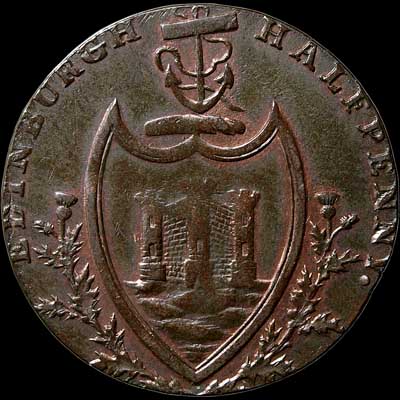
Arms of the City; of Edinburgh. (Argent, a castle triple towered and embattled sable, masoned of the first, windows and portcullis shut of the last, situated on a rock proper.) The portcullis and minor tinctures are not discernible on the token, as the work is on too small a scale. |
| Crest: |
(An anchor entwined with a cable, both proper.) At the sides are crossed thistle sprigs. |
| Legend: |
EDINBURGH HALFPENNY |
|
| Edge:- PAYABLE AT THE WAREHOUSE OF THO.S & ALEX.R IlUTCHISON 'X' |
| Diesinker, Hancock; manufacturer, Hancock. Common. Tokens were also struck bearing the dates 1791 (D&H 31-37), and 1792 (D&H 41-46). In all, ten tons of genuine pieces were struck. There are also several forgeries. Waters gives the figures: 21 pairs genuine dies, 6 pairs of forged dies, and 2 mules. |
| |
| Comments.
Thomas and Alexander Hutchison were merchants in th_ High Street, Edinburgh. |
| The obverse shows St. Andrew - the patron saint of Scotland - and his X-shaped cross, surmounted by the motto Nemo me impune lacessit (None shall hurt me with impunity) of the Order of the Thistle; said to have been instituted by Achaius, King of the Scots, in commemoration of a bright St. Andrew's cross seen in the heavens by the king the night before his victory over Athelstan of England. At a solemn thanksgiving in the Kirk of St. Andrew the Scottish king declared that he and his posterity would ever afterwards bear the figure of this cross on their banners. |
| The reverse shows the Arms of the city of Edinburgh in which the castle, formerly a royal residence and the outstanding feature of the landscape, is shown standing on a rock. To complete the Arms of the city, the Supporters should be given which are:- On the dexter a Maiden richly attired, her hair hanging over her shoulders, and on the sinister a Doe, both proper, the motto being Nisi Dominus frustra. |
| The city is said to derive its name from Edwin, the Anglo-Saxon king of Northumbria, who invaded the Pictish territories in the south of Scotland, and built this castle which was called Edwin's Burgh. This etymology is supported by an old charter granted by David I to Holyrood Abbey in A.D. 1128. |
| Commercial Coins 1787-1804., p. 263-264 |