½ Penny Token (D
& H 370b - Middlesex, Masonic) |
 |
 |
| Obverse - |
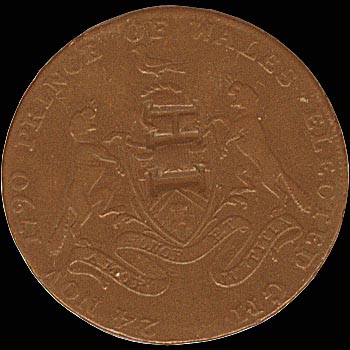
Arms: (Sable [shown as gules on the token] on a chevron
between three towers argent, a pair of compasses extended chevron-wise
of the first). |
| Crest - |
(On a wreath, a dove proper). [The token shows a mound.] |
| Supporters: |
(Two beavers proper) and Motto: (Amor Honor et Justita)
of the Society of Free Masons. |
| Legend: |
24 NOV. 1790 PRINCE OF WALES ELECTED GM. and an ornamental
stop. |
|
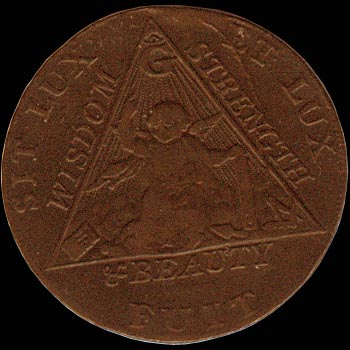
| Reverse - |
A cupid amidst Masonic emblems in a triangle. Along
the sides are inscribed in Italian characters: Wisdom Strength
& Beauty |
| Legend: |
SIT LUX ET LUX FUIT |
|
Edge: There are five varieties of edge inscriptions:-
1. MASONIC TOKEN I. SCETCHLEY FECIT 1794 x.
*2. MASONIC TOKEN I. SCETCHLEY FECIT .+.+.+.
3. MASONIC HALFPENNY TOKEN MDCCXCIV .X.X.X
4. MASONIC TOKEN BROTHER SCETCHLEY BIRMINGHAM FACIT. (sic).
5. MASONIC TOKEN J. SKETCHLEY R.A. & P.G.S. BIRMINGHAM
FECIT * |
| Diesinker, Dixon; manufacturer, Lutwyche. Five
cwts struck. Some of the edges are scarce or rare. |
| *Note: This is a Type 2 edge. It has a
counterstamp of either IH or HI whose purpose I'm unaware of. |
| |
| Comments. James Sketchley (note the correct spelling) was a printer,
publisher and auctioneer: in 1763 he issued the first Birmingham Directory,
which ran to four editions, the last dated 1770 being "Printed by and
for J Sketchley at No. 61, O.Adams No. 83 in High Street; and S. Sketchley,
No. 74 in Bull Street." About 1790 he published a book on Freemasonry
which is now scarce. |
| |
| He was a member of the "Twelve Apostles",
or Minerva Club, a reform society in Birmingham; and he probably migrated
to America. The Gentleman's Magazine for December, 1801, records
the death at Pekipsy, near New York, of Mr. James Sketchley of Birmingham,
and this was probably the issuer of the tokens. He was a freemason. |
| |
| The reverse design shows a cupid and masonic emblems
within a triangle which was regarded as the perfect figure; and in ancient
mysticism was used as a symbol of God. The G at the top of the triangle
also stands for God, and above is the All Seeing Eye. Each object depicted
has its own meaning. |
| |
| Cupid was the god of love; the Bible expressed the will
of God; the Setting Mall symbolised the control over each member's irregularities
of temper exercised by the Master of the Lodge; the Trowel was the jewel
of the Select Master; the Plumb Rule represented upright conduct; the Compass
represented the measure of a mason's life; the Square was the symbol of
morality; WISDOM represented Solomon who was considered the founder of the
order; STRENGTH was one of the three principal supports of masonry; BEAUTY
was the third symbolic pillar supporting a lodge. SIT LUX ET LUX FUIT and
the Lord said: "Let there be light, and there was light." Lux
represented freemasonry, and the mason's search for light in surrounding
darkness. On finding it they became "Sons of Light." |
| Commercial Coins 1787-1804., pp. 197-198 |