½ Penny Token (D
& H 16a - Kent, Dover) |
 |
 |
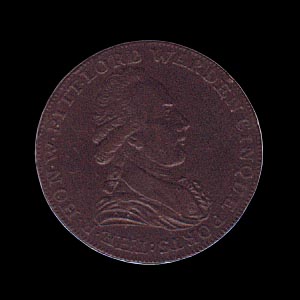
| Obverse - |
Bust of Rt. Hon. W. Pitt. The Prime Minister. |
| Legend: |
THE R. HON. W. PITT. LORD WARDEN CINQUE PORTS: |
|
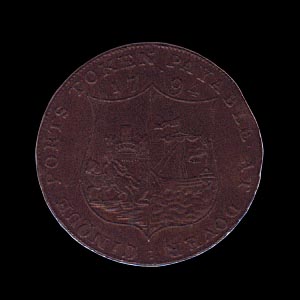
| Reverse - |
A shield bearing a device which appears to have been
taken from the Corporation seal of the Borough of Dover. (A Castle
triple towered with the portcullis up, and issuant therefrom, to the
left, a horseman, to whom a naked figure is kneeling: impaling
a vessel with one mast, afloat, with sails furled and colours flying.) |
| Legend: |
CINQUE PORTS TOKEN PAYABLE AT DOVER: |
| Above the shield |
"17 - 94". |
|
Edge: AT HORN'S LIBRARY the remainder ornamental
engraving.
This edge variant: PAYABLE IN LANCASTER LONDON OR BRISTOL |
| Diesinker, Dixon; manufacturer, Lutwyche, four
cwts. struck. Common. |
| |
| Comments. John Horn was a freeholder with a business as a stationer
and perfumer. He was also an organist and the proprietor of the Apollo circulating
library and Public Reading Room at King's Street in the market place, Dover.
This handsome room was furnished with musical instruments including a very
fine harpsichord, and became a fashionable lounge for the visitors to this
watering place. Horn's son later became a partner, and the firm eventually
Horn and Adlard. |
| |
| There are other tokens, D&H 17, 18, which have been
attributed to John Horn; Diesinker, Dixon; manufacturer, Lutwyche; but the
workmanship is greatly inferior, and the dies are said to have failed after
only a few impressions. They never circulated as currency, and are probably
specious coins made for sale to collectors. |
| |
| William Pitt was appointed Constable of Dover Castle
and Warden of the Cinque Ports by Patent on August 18th, 1792, an appointment
of high honour and trust. The Cinque Ports were Hastings, Sandwich, Dover,
Romney and Hythe, with the addition of the two ancient towns of Rye and
Winchelsea added as Principals, and various other ports as Members. The
Lord Warden was both Chancellor and Admiral of the Confederation and also
Constable of Dover Castle which was his residence, and in earlier times,
his stronghold. |
| |
| Under the Romans a Count of the Sea Coast protected
the southern shores of Britain, and had a standing army under his command.
During the Saxon Heptarchy each king protected his own coast, but when England
was unified under a single monarch the Cinque Ports contributed so frequently
to the fleets fitted out to repel the Danes that Edward the Confessor granted
them many privileges and immunities, which were confirmed by William the
Conqueror, who also appointed the first Constable of Dover Castle, and a
Governor of the Cinque Ports. In succeeding reigns these privileges were
upheld by the sovereigns in return for the shipping supplied by these ports
in time of war, both for defence of the coast and the transport of troops
and the king's person. The last charter granted to them was by Charles II,
and confirmed by James II. |
| |
| There was a priory of St. Martin in Dover, and the reverse
of the token, derived from the Corporation seal of the town, refers to the
legend of this saint who gave away his garments to the poor, retaining only
his cloak, but when he was met by a naked beggar at the gates of Amiens,
St. Martin immediately cut his cloak in half to share it with this new unfortunate. |
| |
| The rest of the design at first glance simulates the
device of a Cinque Port; but closer inspection reveals that the ship is
not an antique English Round Ship, but a small coastal vessel flying a Union
Jack. |
| Commercial Coins 1787-1804., pp. 69-71 |