½ Penny Token (D
& H 38 - Kent, Romney) |
 |
 |
| Obverse :- |
An antique vessel with one mast and colours flying,
drawn up on a beach. The design between crossed laurel branches. |
| Legend :- |
THE SUCCESS. |
|
| Reverse :- |
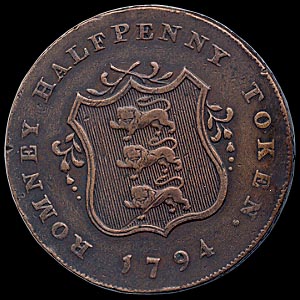
Arms of the town of New Romney (Azure [this is shown
as gules on the token] three lions passant guardant in pale or) [These
are shown on the token as argent] with inverted and crossed sprigs
behind the shield, shown as projecting above and on either side of
it. |
| Legend :- |
ROMNEY HALFPENNY TOKEN. 1794 |
|
| Edge:- PAYABLE AT IOHN SAWYER'S ROMNEY . X . |
| Diesinker, Wyon; manufacturer, Lutwyche. Two
cwts. struck. Scarce. |
| Size, 29 mm. |
| |
| Comments. John Sawyer was a freeholder with a business as a carpenter
and joiner in Romney, which is in the lathe of Shepway and some eight miles
from Hythe. |
| |
| The design and legend of the obverse is a mystery. Possibly
it refers to the success of the ships of the men of Romney against a small
part of the fleet of William the Conqueror. This victory later cost them
dear when the Norman entered Kent by land. |
| |
| Romney was one of the Cinque Ports, and in the thirteenth
century the " Royal Navy of the Cinque Ports " consisted of twenty-one ships
from the western ports: Hastings six, Winchelsea ten, and Rye five: and
thirty-six ships from the Eastern Ports: Dover twenty-one, and Hythe, Sandwich
and 'Romney five each. These vessels were between twenty and forty tons
and were merely coastal traders and fishing boats fitted up for war with
a forecastle and an aftercastle, and a smaller one at the mast head. They
were square rigged with a single sail, and carried twenty-one men and a
boy. Sea fighting was little more than land fighting transferred to an uncongenial
element. |
| |
| The life of Romney as an active Cinque Port virtually
ceased with the great storm of 1287 when the sea flooded the area and huge
deposits of silt ruined the harbour and changed the course of the river.
|
| |
| The heraldic error in showing the field as gules when
it should be azure is unfortunate, and such mistakes may cause difficulty;
but as tokens were produced at competitive prices the artists were unable
to spare the same time for research as was devoted to the production of
high class medals. Nevertheless many tokens were very carefully executed. |
| Commercial Coins 1787-1804., pp. 78-79 |