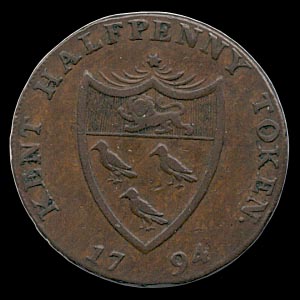
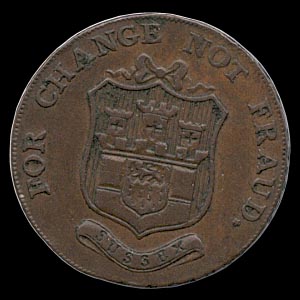
Great Britain - 1794

½ Penny Token

(D & H 35a - Kent, Lamberhurst)
Obverse - Great Britain  - 1794 Reverse - Great Britain - 1794
Obverse - Arms of the City of Canterbury.
Legend: KENT HALFPENNY 17-94
Reverse - Arms: apparently taken from the corporation seal of the City of Chichester (Gules, a castle triple-towered, the portcullis down - not shown on the token - and on the front of the castle a shield of Arms; Argent, gutte de poix; on a chief indented gules, a lion passant guardant or.) The shield suspended from a knotted riband and beneath it an escroll bearing the word "Sussex".
Legend: FOR CHANGE NOT FRAUD, with ornamental stop.
Edges:- (1) PAYABLE BY I. GIBBS LAMBERHURST + + +
  (2) PAYABLE BY + I. + GIBBS SUSSEX.
Diesinker, Wyon; manufacturer, Lutwuche. Four cwts. struck. Common.
The Sussex edge is scarce. (This example is a type 2 edge.)
 
Comments. Lamberhurst was a small town built on either side of the turnpike road from Maidstone to Hastings. The portion north of a bridge crossing the Teise, a tributary of the Medway, was in Kent, and the portion to the south of the bridge in Sussex. As J. Gibbs made one of his specimens payable in Sussex, it suggests that he lived on the south side of the bridge. The arms of the capitals of the two counties were very appropriate designs for this border town.
Commercial Coins 1787-1804., pp. 75-76
 
D & H 35a - Kent Halfpenny
O: Shield of arms of the city of Chichester. Below on a label SUSSEX. FOR CHANGE NOT FRAUD.
R: Shield of arms of Canterbury. KENT HALFPENNY TOKEN. 1794.
E:
A. 33a
PAYABLE BY + I. + GIBBS SUSSEX.
 
The two authorities reverse the sides and Commercial Coins omits the word "TOKEN" even though the illustration in the book clearly shows it.