½ Penny Token (D
& H 2 - Sussex, Brighton) |
 |
 |
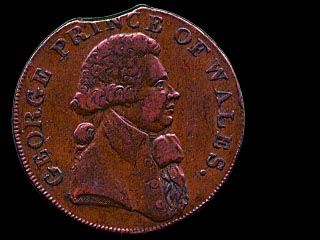
| Obverse - |
Bust in eighteenth century attire. |
| Legend - |
GEORGE PRINCE OF WALES. |
|
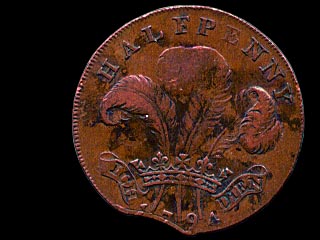
| Reverse - |
Badge of the Prince of Wales. (Three ostrich feathers
argent, quilled or, enfiled in base by a coronet composed of crosses
patée and fleur-de-lys alternately); and Motto: on a riband issuing
from the coronet, "Ich Dien". |
| Legend: |
HALFPENNY 1794 |
|
| Edge: BRIGHTON CAMP HALFPENNY X.X.X |
| Diesinker, Wyon; manufacturer, Lutwyche. Common. |
| |
| Comments. These tokens were circulated by Richard Maplesden, a
grocer and draper in Winchelsea. The first type struck have the edge inscription:
PAYABLE AT RICHARD MAPLESDEN'S WINCHELSEA. Others BRIGHTON CAMP HALFPENNY
MDCCXCIV X.X and yet others PAYABLE AT LONDON OR BRIGHTON He also issued
the Warley Camp tokens, see Essex No. 7. In all, including the Warley Camp
tokens, ten tons were issued. |
| |
| The Prince of Wales, later George IV, first visited
Brighton in 1782 and taking a liking to the town, purchased the residence
of a Mr. Thomas Kemp. He built the Pavilion which was commenced in 1784
and finished in 1787; an extravaganza described by a contemporary as "St.
Paul's gone to the seaside and pupped." Much of his time at Brighton
was spent in the company of Mrs. Fitzherbert, his legal though disclaimed
wife. |
| |
| The first Brighton Camp was formed during the French
invasion scare; the Prince meeting the troops on the outskirts of the town,
and they pitched their tents at Belle Vue Field. The encampment consisted
of regular troops and militia; its maximum strength was 10,000 men, and
they were kept under arms from 13th August to 28th October, 1793. |
| |
| In the following summer a second camp was established
about a mile and a half to the west of Brighton, its maximum strength reaching
nearly 15,000. In 1795 there was a third camp at Brighton, made memorable
by two men being shot and others flogged for mutiny. |
| Commercial Coins 1787-1804., pp. 179-180 |