| |
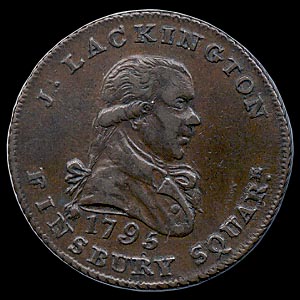
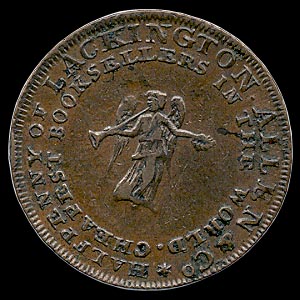
| Comments. There is a variety of this token, D&H 358, with the figure
of fame on the reverse smaller; there is no separating line between the
inner and outer legend, and the lettering is smaller and neater. Common.
(This is that variety) |
| |
| In all, seven tons of these tokens were struck, making Lackington the
largest issuer of commercial coins in London. |
| |
| The Memoirs of the First Forty-Five Years of the
Life of lames Lackington, written by himself and published in 1791,
provide ample information about this enterprising and ambitious man. His
story is the popular one of a destitute boy who became wealthy through his
own exertions and ability. He was born in Wellington, Somerset, in 1746,
and as a child sold halfpenny pies by crying them in the streets. At fifteen
he was bound apprentice to a shoemaker in Taunton, where he joined the Wesleyans
and learnt to read. When he was out of his time he went to Bristol, Bridgwater,
Taunton and Exeter, in search of work and settled at Kingsbridge where he
taught himself to write in his spare time. He was twenty-three. |
| |
| He married in 1770, and the day after the wedding the
bridal pair had only a halfpenny, and the clothes they stood in. Lackington's
wages were 9/- a week, and his wife turned to shoebinding to supplement
their meagre income, but ruined her health in the attempt. |
| |
| In 1773 James travelled alone to London and worked as
a journeyman shoemaker for a Mr. Heath, in Fore Street, Cripplegate. His
wife later joined him and worked for the same master. Lackington began to
buy and sell second-hand books, and in 1774 he set himself up as a bookseller
at No.46 Chiswell Street. Shortly after this both Lackington and his wife
were ill, the latter dying. In 1776 he married again; and in 1778 entered
into partnership with John Dennis, an oil man, who provided much needed
capital. The partnership, known as Lackington & Co., was dissolved by mutual
consent in 1780. Lackington built his business on a basis of small profits
with quick sales and no credit. |
| |
| As the business grew he bought No.47 Chiswell Street
and extended his premises. By 1791 the profits reached £4,000 a year. In
1794 he opened the grandiloquently styled "Temple of the Muses" and the
tokens were issued from this establishment. In 1795 Peregrine Pinda published
a severe skit entitled Ode to the Hero of Finsbury Square congratulatory
on His Late Marriage and illustrative of His Genius as his own Biographer.
Verse 30 refers to the tokens: - |
| "But tho to Merit envy's ever blind, |
| (The Muse tells Truths-and who shall dare to stop her?) |
| It could not check 'Our Hero's' active Mind |
| From sending forth his Miniature-in copper! |
| And Moorfield's Coin was hail'd with many a grin |
| Till Hints came out, and then the Coin went in!" |
|
| Lackington retired in 1798, leaving the business in
the hands of his third cousin George Lackington, and Robert Allen, both
of whom had been in the shop since boyhood. In 1804 he published a volume
of "Confessions" which was written to contradict some of the religious views
expressed in his "Memoirs". His last years were spent as a retired gentleman
in Budleigh Salterton where he died in 1815 at the age of 69. |
| Commercial Coins 1787-1804., pp. 111-112 |