| |
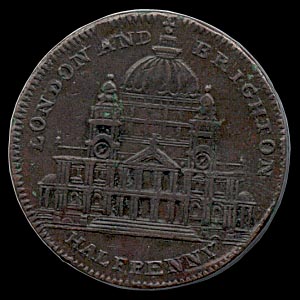
| Comments. There is a common variety with ST. PAUL'S, inserted beneath
the building and the letters I.P. in small Roman Capitals appear just below
the letter N in the word BRIGHTON of the obverse legend. |
| |
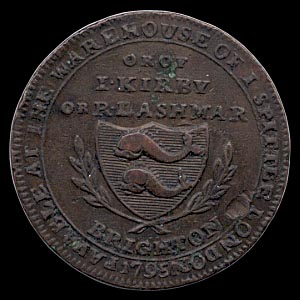
| This token was issued by three tradesmen. The London issuer,
James Spittle, was a cheesemonger at No.6 Broadway, Blackfriars, close to
St. Paul's; Richard Lashmar was a shopkeeper at Brighton; and J. Kirby a
grocer in the same town. |
| |
| St. Paul's cathedral is 360 ft. high from the pavement,
and the artist has given considerable detail in his design; even the statues
of St. Paul at the apex of the pediment, and those of St. Peter and the
Evangelists at the sides and angles, are shown. |
| |
| The Arms are those of the Lashmar family, though possibly
derived from the Town Seal of Brighton. (Argent, two dolphins naiant in
pale, apparently proper.) Brighton was not incorporated until 1854. |
| |
| Pye does not record the diesinker or manufacturer of
these tokens; and Sharp assigns them to James, but this is not his usual
style, and the execution of the piece suggests Birmingham manufacture; and
a curious error supports this suggestion - note that two clocks are shown,
one in either tower of the front of the cathedral, whereas the north- western
one should be empty. A London man would hardly have made this error, or
certainly not repeated it in the second die. The letters I.P. may represent
the initials of James Pitt as the manufacturer. |
| |
| In 1779 Richard Lashmar was the High Constable of the
Hundred of Wellsbourne, otherwise Whalesbone, within which Brighton is situated. |
| Commercial Coins 1787-1804., pp. 121-123 |