Great Britain - 1795

½ Penny Token

(D & H 246a - Middlesex, Allen's)
Obverse - Great Britain  - 1795 Reverse - Great Britain - 1795
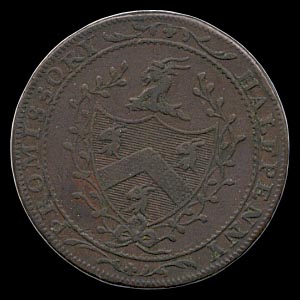
Obverse - Arms: (Azure, a chevron or, between three goats' heads erased argent, attired of the second), and Crest: (On a wreath a goat's head erased argent, attired or), of the Cordwainers' or Shoemakers' Company, within a ribbed circle and between crossed sprays of leaves, tied beneath the shield with a bow of ribbon.
Legend: PROMISSORY HALFPENNY with floral ornaments separating the words.
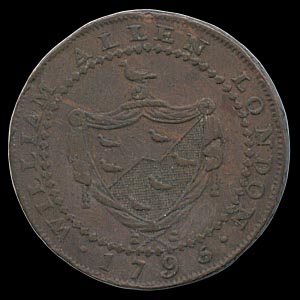
Reverse - Arms (Parted per bend sinister rompu, argent, and sable, six martlets counter-charged: the shield duly mantled), and Crest (A martlet argent, winged or) within a circle of leaves. The token is too small to permit the tinctures of the birds in the arms and crest to be shown, and the latter should have an acorn or, leaved vert, in his beak.
Legend: WILLIAM ALLEN LONDON. 1795.
Edge:- PAYABLE IN CHANDOS STREET, COVENT GARDEN
This edge: PAYABLE AT LONDON .+.+.+.+.+.
Diesinker, Dixon; manufacturer, Lutwyche. Three cwts. struck. Common.
 
Comments. The arms on the reverse are those of William Allen's family. He appears to have been a boot and shoe maker, with a business at No. 36, Chandos Street, which was later continued by other members of his family well on into the nineteenth century.
 
   The obverse displays the arms of the Cordwainers' or Shoemakers' Company. The London Company is said to have existed in the reign of Henry III, and been incorporated by Henry IV in 1410 under the title of Cordwainers and Cobblers! The word Cordwainer arose from Corduaners being manufacturers of Corduan leather from Cordua (Cordova) in Spain; while a cobbler was not only a shoemaker, but also a dealer in shoes. The Company is now "The Master Wardens and Commonalty of the Mystery of Cordwainers of the City of London".
Commercial Coins 1787-1804., p. 95-96
 
D & H 246a - Allen's
O: Shield of arms. WILLIAM ALLEN LONDON, 1795.
R: Shield of arms. PROMISSORY HALFPENNY
E:
A. 167a
PAYABLE AT LONDON .+.+.+.+.+.
 
This isn't the variant mentioned by Bell; it is an equally common edge variant.