| |
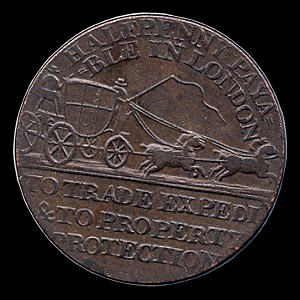
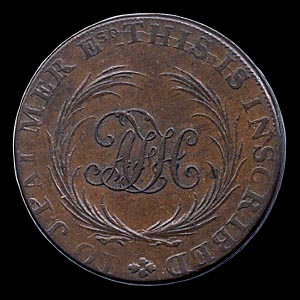
| Comments. The issuer is unknown, but may have been Anthony Fra
Haldimand, a merchant of 58, St. Mary Axe, whose name appears in the Universal
British Directory of 1790. |
| |
| The first riding post appears to have been organised
by Cyrus, the Persian. The earliest letter post was established in the Hanse
towns in the early part of the thirteenth century, while in England letters
were conveyed a few years later by paid royal messengers. Edward IV established
regular riding posts, and Henry VIII improved the service and appointed
a "Master of the Postes." In the seventeenth century the posts were carried
in a valise strapped behind mounted messengers who travelled at a regulation
5 m.p.h. in winter and 7 m.p.h. in summer. There was little further improvement
until Mr. John Palmer, the manager of the Bath and Bristol theatres, and
a man of private means, persuaded the government to let him operate a plan
for mail coaches. The experiment took place in August 1784 when Palmer's
coach left London at 8 a.m. and arrived in Bristol at 11 p.m. the same evening. |
| |
| Palmer was appointed Controller General of the Post
Office, with a salary of £1,500 a year, and a contract with a percentage
on all letters carried, but this part of the agreement was not ratified
by Parliament. Palmer met constant opposition to his plans from the Post
Office Authorities and was forced to resign in 1792, with a pension of £3,000
a year. He died in 1818. |
| |
| An annual procession of mail coaches was held in London
on the sovereign's birthday when, freshly painted and with the servants
in new uniforms, they made a fine spectacle, and departed on their respective
journeys amid the cheers of the populace. |
| Commercial Coins 1787-1804., pp. 113-114 |