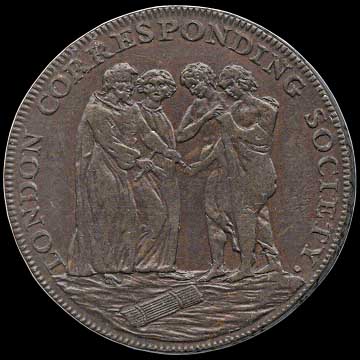
| These moves dealt the radical London Corresponding Society
a severe blow, but its members continued to fight in support of Paine's
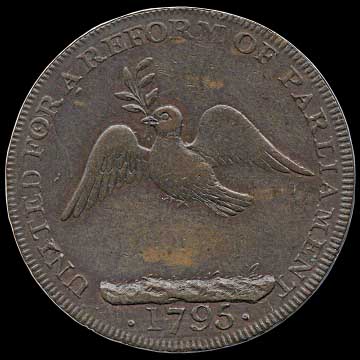
ideals and struck a token (DH Middx 285) depicting four figures, with the
words 'London Corresponding Society'. The reverse shows a dove with an olive
branch, and 'United for a reform of Parliament, 1795'. This society had
been started in 1792 with an entrance fee of 1s and a weekly subscription
of 1d, its members calling each other 'citizen'. It linked Manchester, Stockport,
Sheffield and Norwich with London, and campaigned strongly for such reforms
as universal manhood suffrage and yearly parliaments. Its founder was a
shoemaker, Thomas Hardy, who was one of those acquitted of high treason
in 1794. On 27 October 1795, 150,000 members had gathered at Copenhagen
Fields, London, and passed a resolution virtually calling for civil war.
An unpoliced London, thoroughly frightened by the fearsome events of the
French Revolution, was easily stirred. On 29 October, the King's coach was
stoned, though on the following day the Covent Garden audience greeted the
King by singing the National Anthem six times over. The 1795 Acts faced
the society with the problem of being unable to hold meetings legally and
it soon had a debt of £185. By 1798 it was so changed that it even
debated a motion to form a corps to resist the French invasion then feared.
The establishment of the day had won." |