½ Penny Token (D
& H 345 - Middlesex, Kelly's) |
 |
 |
| Obverse - |
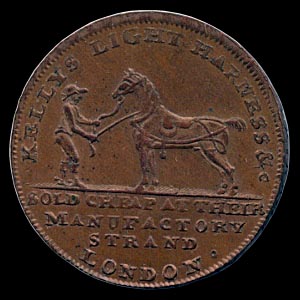
A postillion holding a horse with saddle and harness. |
| Legend: |
KELLYS LIGHT HARNESS &C |
| In the exergue, |
SOLD CHEAP AT THEIR MANUFACTORY STRAND LONDON. |
|
| Reverse - |
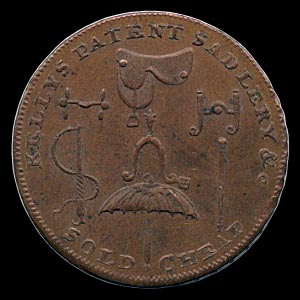
A saddle between two bridle bits, beneath these a spur
between two riding whips, and an umbrella below the spur. |
| Legend: |
KELLYS PATENT SADLERY &C SOLD CHEAP |
|
| Edge:- PAYABLE AT LONDON -+-+ -+-+-+-+-+ -+ .+ |
| Diesinker, Dixon; manufacturer, Lutwyche. Ten
cwts. struck. Common. |
| |
| Comments. J. and S. Kelly, at No.139 Strand, were saddlers, patent
whip-makers to the Prince of Wales and Duke of York, and manufacturers of
spurs, walking canes, etc. |
| |
| Saddles were probably introduced into England by the
Romans, and were certainly known to the Saxons, but without stirrups. |
| |
| Spurs are said to have been used by the Greeks and Romans,
and are represented on seals of the eleventh century. They were used by
the Saxons, being made of iron or brass with a single fixed sharp point,
instead of a rowel, and fastened to the shoe by a leathern thong. Knights
of old wore golden spurs, and their squires silver ones. The rowel is mentioned
in the reign of Henry III. |
| |
| Whips and bridle bits are found on ancient sculpture
but the curb was introduced into England about the reign of Charles I. |
| |
| A Mr. Jonas Hanway returned from Persia during the middle
of the eighteenth century and introduced the umbrella into England. The
hackney coach and sedan chairmen regarded it as a threat to their livelihood
since a shower of rain sent most pedestrians in search of transport, and
so the lower classes and street gamins of the Metropolis hailed the appearance
of an umbrella in the streets with hoots and cat-calls and suggestions in
forthright language to "get a coach." |
| |
| The early umbrellas were formidable pieces of equipment
made of heavy waxed cloth with cane ribs, and with a ring at the cloth end
for carrying on a finger, or hanging on a peg in the hall. Portable, and
even "Pocket" umbrellas soon followed. |
| Commercial Coins 1787-1804., pp. 106-107 |