½ Penny Token (D
& H 20 - Angusshire; Dundee.) |
 |
 |
| Obverse - |
View of a large building with towers. |
| Legend: |
DUNDEE HALFPENNY. 1797 |
| In the exergue, |
DUDHOPE CASTLE FOUND.D 1660. CONVERTED INTO BARRACKS 1794 |
|
| Reverse - |
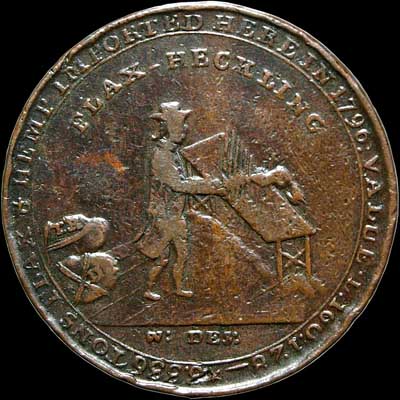
A man in a tail coat and a hat working at a hachel, or bench fitted with upright teeth, hackling flax. Behind him are two bales on the floor, one marked T.R. and the other D.R. |
| Legend: |
3,336 TONS FLAX & HEMP IMPORTED HERE IN 1796. VALUE. L. 160,128 |
| Inner legend: |
FLAX-HECKLING |
|
| Edge:- Plain. |
| Diesinker. Wyon; manufacturer, Kempson. One ton
struck. Common. There are two minor variants. |
| |
| Comments. There were two rope making companies in Dundee, the Tay Ropery, and the Dundee Ropery, and it is conjectured that T.R. and D.R. stand for these firms. James Wright issued farthing pieces similarly marked, and therefore it is probable that he was also responsible for this halfpenny. |
| |
| The designs suffer from Wright's idiosyncracies. There is far too much lettering, and the manner in which the 1794 has escaped out of the obverse exergue is very odd. |
| |
| The ruins of Dudhope Castle stand on a hill about a mile from the old town of Dundee, and was the stronghold of the Scrymgeours, the Hereditary Constables of Dundee. Later the building was used as a woollen mill for a short time, and then was leased to the Crown for barracks, as mentioned in the legend. |
| |
| Hackling is a process in the preparation of flax, when the filaments are teased into fine fibrils. The flax is watered and swingled and then the worker, as seen on the token, draws the strike of flax over the hatchel teeth, until the tow has been removed and the fibres lie in long parallel strands. |
| |
| Wright is thought to be the author of several articles in the Gentleman's Magazine and other periodicals of the time upon the token coinage, under the nom de plume of "Civis". |
| Commercial Coins 1787-1804., pp. 244-245 |