|
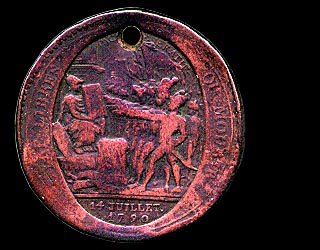
Fortunately I acquired the nice example first, in fact several years
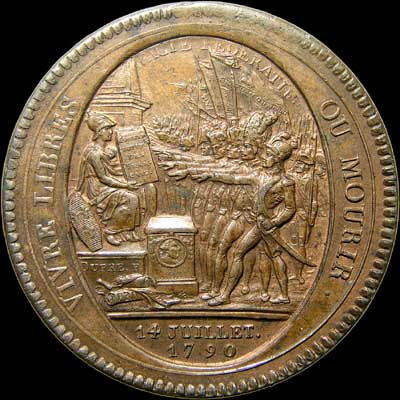
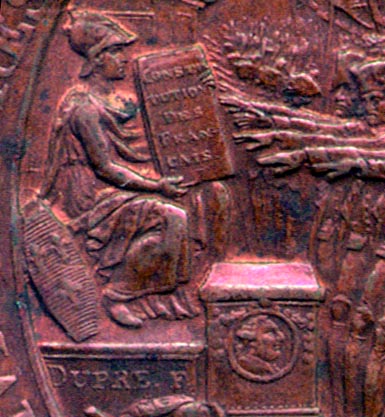
ago. Look at the tremendous detail of this token. I chose this portion
of the token because of several interesting points: the fleur-de-lys on
the shield, the portrait of Louis XVI, the image of France as a helmeted
young woman, the Constitution of the French, the swearing soldiers. All
this, plus the date of July 14, 1790 clearly identify this as prior to
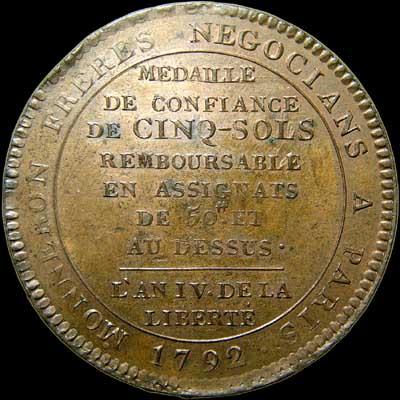
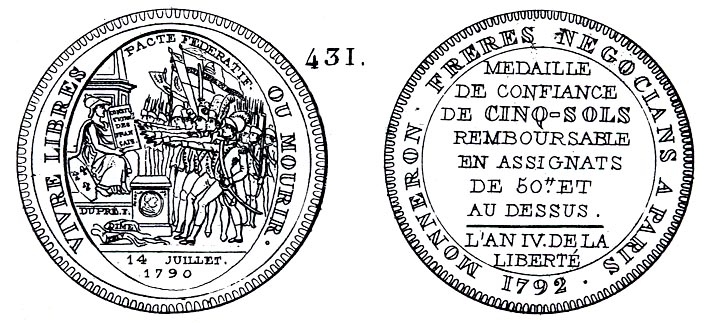
the King's execution. Also, the date 1792 on the reverse would also tend
to date it to this period.
"Another wonderful design by Dupré. The date l'An IV de la
Liberté refers to the French Constitutional Calendar and therefore
translates as 1792. The scene on the obverse recalls the Oath of the Federation,
the first anniversary of which was celebrated by the Festival of the Federation
on 14 July 1790 (hence that date in the exergue). The Festival, which
included a mass held by the great French statesman Talleyrand (1754-1838),
then the Bishop of Autun, also commemorated the taking of the Bastille
and the bond which united the nation with the king and the people.
This coin, or more correctly token, was actually minted in my home city
of Birmingham, England. From the end of 1791 Matthew Boulton, utilising
his new steam driven coin presses, was commissioned by the Monneron Brothers
to produce 2 and 5 sols pieces in great quantity at his Soho Mint near Birmingham
(Birmingham has grown considerable since those times and now encompasses
the site where the mint once stood). According to various sources, the total
weight of these coins produced was in excess of 70 tonnes, implying a fabrication
of 2,334,000 pieces weighing 30 gms. each. These 'monnaies de nécessité'
were to be used to remedy the lack of specie which plagued France during
the early revolutionary years. The technical and aesthetic quality of the
tokens was far superior to the mediocre, officially produced base metal
coins of the time. |
| In March 1792, the Monneron Brothers became bankrupt and one brother,
Pierre, fled the business. Under the other brother Augustin, the business
recovered, but a law of 3rd May 1792 forbade the production of privately
issued coinage. In September, a further decree also forbade the marketing
of these 'Medailles de Confiance'. This emergency coinage only remained
in circulation therefore until the end of 1793. Most of this information
was obtained from the aforementioned French web site www.cgb.fr
" |