CII - 1809
| Attaque d'Anvers, et séjour a Schoenbrunn. | |||||||||||||
 |
 |
||||||||||||
|
|
||||||||||||
| Size, 1 5/8 inches. | |||||||||||||
Laskey's Narrative:
| This medal, was struck by the order of the French government, on the attack of Anvers by the English, and the taking possession of the imperial palace of Schoenbrunn at Vienna, by the Emperor Napoleon, where he established the head-quarters of the French army, and from whence he issued a proclamation addressed to the Hungarian nation. |
 |
| Edwards - 478 | ||||
|
||||
|
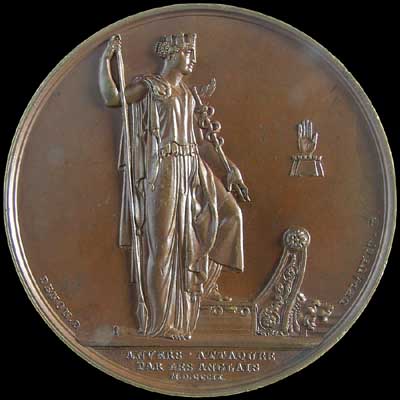
R. Antwerp attacked. | |||
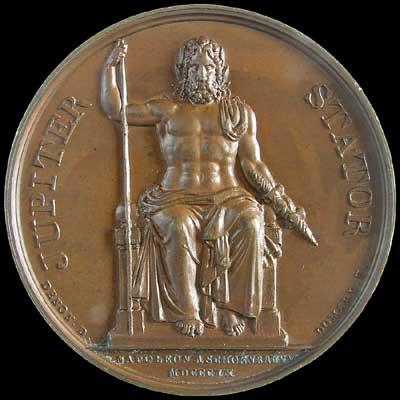
| JUPITER STATOR. Jupiter seated on his throne, leaning on his spear, and holding the fulmen. Exergue: NAPOLEON A SCHOENBRÜNN MDCCCIX. (Napoleon at Schœnbrünn, 1809.) Above the exergue, circularwise, to the left: DENON D. (direxit); to the right: DOMARD F. (fecit). | ||||
| R. The city of Antwerp personified, in a standing posture, the right hand supported on a reversed lance, and a caduceus in the left; one foot being planted on the prow of a vessel. On the right, three towers, and above them, a hand, the arms of the city of Antwerp. Exergue: ANVERS ATTAQUÉE PAR LES ANGLAIS M.D.CCCIX. (Antwerp attacked by the English, 1809.) Above the exergue, circularwise, to the left: DENON D. (direxit); to the right: DEPAULIS F. (fecit). [40"] | ||||
| Paris Medal Mint. | ||||
| At the end of July 1809, the English appeared in the Scheldt with a numerous array of vessels and troops. On the 15th of August they carried Flushing, but here their success terminated, and they were soon compelled to abandon the country, defeated by diseases and by the resistance which was opposed to them. This expedition, intended to effect an important diversion of the affairs of the Austrian campaign and the negotiations with the Court of Vienna, was in fact without result. Napoleon remained firm at Schœnbrunn, directing the negtiations and leaving the empire to defend itself. The type of Jupiter Stator employed on the medal above described is an allusion to this firmness. The medal appears to be appropriately referred to the 31st August, 1809. | ||||
| Bramsen - 870 Anvers attaquée par les Anglais. (Domard et Depaulis.) |
|
| JUPITER STATOR. Jupiter assise sur son trône. | Rev: La ville d'Anvers debout; à droite, trois tours surmontées par une main, armes d'Anvers. |
| Exergue: NAPOLEON A SCHOEN BRÜNN MDCCCIX. | Exergue: ANVERS ATTAQUÉE PAR LES ANGLAIS M.D.CCCIX. |
| Médaille, 40 mm. - T. N. 33, 4. | |
| d'Essling - 1247 Attaque d'Anvers par les Anglais. (Domard et Depaulis). |
|
| Jupiter assise de face. | R. La ville d'Anvers deb. à dr. |
| (TN. 33.4 - M. 241 - B. 870). Arg. et br. 41 mm. | |
| Milan - 688 Anversa — Attacco inglese — Battaglia di Essling |
|
| D. JUPITER STATOR Nel centro, al centro, Giove seduto frontale, su trono, regge con la mano d., scettro e con la s., fulmine; in basso, sopra il taglio della base, a s.: DENON. D. ed a d.:DOMARD. F. All'esergo: NAPOLEON A SCHOENBRÜNN / MDCCCIX. Contorno a piatto e gola. |
R. ANVERS ATTAQUEE / PAR LES ANGLAIS / M.D.CCCIX. (all'esergo) Nel campo, al centro, figura femminile (Anversa), paludata, stante a d., con piede s. su prora, regge con la mano d., scettro e con la s., caduceo; nel campo, a d.,stemma di Anversa; in basso, sopra il taglio della base, a s.: DENON D. ed a d.: DEPAULIS F. Contorno a piatto e gola. |
| Autore: Domard / Depaulis; | Data: 1809 |
| Caratteristiche tecniche: Argento; | Ømm 40,5; 0; Coniazione |
| Bibl.: Bramsen, n.870; Julius, nn. 2127-2128; Essling, n.1247; Millin, n.241; De Félissent, --- | |
| Medaglia coniata in epoca successiva al 1820 (?). | |