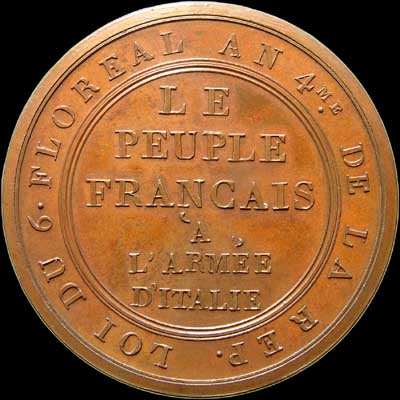
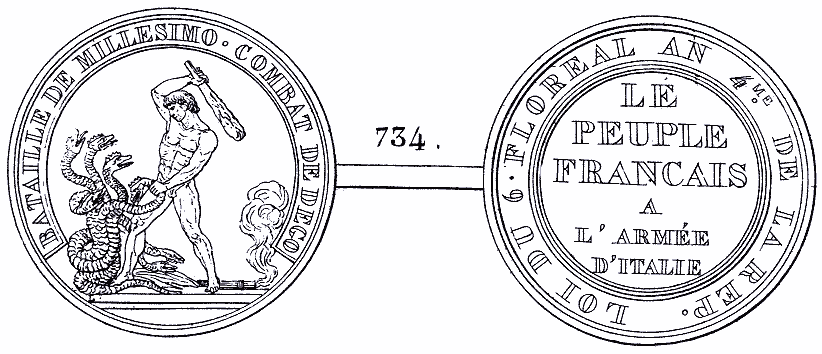
| The battle of Millesimo, on account of which victory
this medal was struck, being the second in which Bonaparte was engaged after
being appointed to the chief command, and being so closely connected with
the battle of Montenotte, we conceive we cannot do better than continue
the operations of the army after that battle, in explanation of this. |
| Beaulieu was yet able to send assistance from his right
wing to the left of the Austro-Sardinian army. Bonaparte changed his head-quarters
to Carcara on the 12th, and ordered General Laharpe to march to Sozello,
in order to threaten the eight battalions of the enemy stationed there,
and on the day following, by a rapid and concealed march, to get to the
town of Cairo, while General Massena was to gain the heights of Dego, at
the time that the Generals Menaud and Joubert occupied one of the heights
of Biestro, and the other the position of St. Marguerite. This movement
following the battle of Montenotte, placed the French army on the other
side of the Alps. |
| General Augereau forced Millesimo, while the Generals
Menaud and Joubert drove the enemy from all their posts, and surrounded
a corps of 1500 Austrian grenadiers, commanded by Lieut-General Povera,
a knight of the order of Maria Theresa, who gallantly retired to the mountain
of Cossaria, and entrenched himself in an old castle, extremely strong on
account of its position. Augereau ordered his artillery to advance, when
a cannonade was kept up for several hours. In the course of the day, Bonaparte,
vexed at finding his march checked by a handful of men, ordered General
Povera to be summoned to surrender. He requested to speak with the Commander-in-Chief,
but a lively cannonade commencing on the right wing of the French, hindered
him from going to Povera, who then entered into treaty with General Augereau,
which lasted for several hours without coming to a conclusion: Augereau
at length formed his men into four columns, and advanced against the castle.
Joubert entered the enemy's works with only seven men; when, being wounded
in the head, he fell to the ground: his soldiers thinking him killed, his
column relaxed. The second column, under General Banel, advanced in silence,
when the General was killed. The third column, under Adjutant-General Quenin,
who was also killed, was in like manner disconcerted. |
| Night approaching, Bonaparte fearing the enemy would
attempt to make their way sword in hand, made dispositions to prevent them. |
| Next morning the hostile armies faced each other. The
French left, under Augereau, kept General Povera blockaded. Several of the
enemy's regiments strove to penetrate the center of the French, but were
repulsed by General Menaud, who was then ordered to fan back on the right
wing. Before noon General Massena extended his line beyond the enemy's left,
which occupied the village of Dego, strongly entrenched. The French pushed
their light troops as far as the road leading from Dego to Spino. General
Laharpe's division marched in three close columns; the one on his left,
under General Causse, crossed the Bormida, and attacked the right of the
enemy's left wing; General Cervoni, with the second column, also passed
the Bormida, covered by one of the French batteries, and advanced against
the enemy; while the third column, under Adjutant-General Boyer, turned
a ravine, and cut off their retreat. The enemy had not time to capitulate;
and the French columns, spreading terror and death, put them to the route.
General Povera, with the corps he commanded at Cossaria, surrendered prisoners
of war. By this victory the French acquired from 7 to 9000 prisoners, and
the enemy had near 3000 killed on the field. |
| On the 15th, Beaulieu, with the flower of his army,
attacked the village of Dego and carried it. Massena, when he had formed
part of his troops, began the attack, but was repulsed in three attempts.
General Causse was not more fortunate; he attacked the enemy, and was on
the point of charging with the bayonet, when he fell, mortally wounded.
In this situation, observing General Bonaparte, he collected his strength,
and asked him if Dego was retaken; " The posts are our's," replied
the General. Then said Causse, " Vive la République!-
I die content." The affair, however, was not yet decided, and it was
already two o'clock in the afternoon. Bonaparte ordered a demi-brigade to
form under General Victor, whilst Adjutant-General Lasnes rallying a demi-brigade
of light infantry, threw himself on the enemy's left. These movements carried
Dego; the cavalry completed the route of the enemy, who left 600 dead and
1400 prisoners. General Rusca took the post of San Giovanni, which commands
the valley of Bormida. General Augereau, having drove the enemy from the
redoubts of Montezemo, communicated with the valley of Tanaro, which the
division of Serrurier had already occupied. |
| The Directory, in their dispatches to Bonaparte, expressed
themselves thus: " To-day, General," said they, "receive
the tribute of national gratitude; merit it more and more, and prove to
Europe, that Beaulieu, by changing the scene of action, has not changed
his opponent; that, beaten in the North, he shall be constantly defeated
by the brave Army of Italy; and that with such defenders, liberty shall
triumph over the impotent efforts of the enemies of the Republic." |