XCVI - 1808
| Bataille de Sommo-Sierra | |||||||||||||
 |
 |
||||||||||||
|
|
||||||||||||
| Size, 1 5/8 inches. | |||||||||||||
Laskey's Narrative:
| Napoleon having entered Spain, in order to conduct the operations of the war, and the conquest of that kingdom, and the patriotic armies under Generals Belvedere, Blake, and Castanos, having been successively defeated at Burgos, Espinosa, and Tudela; the Emperor forced the pass of Sommo Sierra, called Puerto, and advanced to Madrid: this important pass lies over the mountains which divide Old and New Castile; it was defended by 13,000 men of the Spanish army of reserve, under the orders of General San Juan, with sixteen pieces of cannon, and was forced by a division under the command of the Duke of Belluno, on the 30th November, 1808. |
|
Sommo Sierra was the site of some of the greatest bravery exhibited during the Napoleonic Wars. Napoleon was determined to capture Madrid and the Spanish Junta equally determined that he shouldn't get there without a fight. In his hurry to cross the Somosierra pass Napoleon neglected to properly assault the 16 cannon mentioned by Laskey and he began to get bogged down. Annoyed, he turned to Captain Korjietulski (or Kozietulski), commander of the Third Squadron of the Polish Light Horse, who were the current escort for the Emperor, and ordered them to take the position at the gallop. In a near suicidal charge, lasting only seven minutes, nearly 70% of the squadron became casualties. Actually, different authorities have different numbers involved and casualties suffered. One says 60 of 88 who charged (approx. 70%) while another says 82 of 150 (55%). Napoleon leaned over the bleeding body of Lt. Niegolewski who had captured a battery of guns with his troop and, removing his own cross of the Legion of Honor, pinned it on him. Forty-seven years later the Lieutenant would write, "would that many a youth might live to see such a day!" A second charge by two remaining squadrons was executed as part of a correctly coordinated attack on the position. With minimal losses the cannon were all captured. Napoleon typically failed to mention the first charge in his bulletin of December 2nd, 1808 but there is evidence that he never forgot the Poles' bravery and sacrifice. Napoleon later would award sixteen crosses of the Legion of Honor, ending the ceremony by taking off his hat and crying, "You are worthy to belong to my Old Guard. Honor to the bravest of the brave!" |
|
Bramsen - 756 |
||
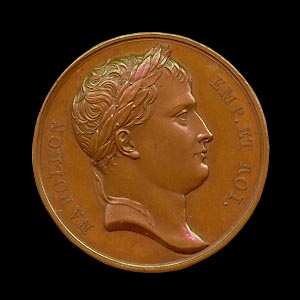
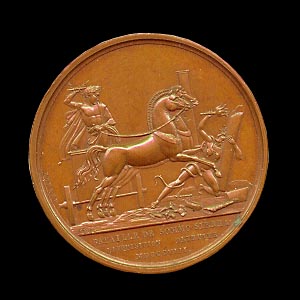
| NAPOLEON EMP. ET ROI. Tête laurée, à droite. | Rev: Napoléon debout, dans un char attelé de deux chevaux, foudroie le génie de l'Inquisition, qui, renversé sous les chevaux, lui dispute le passage entre les colonnes d'Hercule, et qui, dans sa chute, a entraîné une de ces colonnes. | |
| Exergue: BATAILLE DE SOMMO SIERRA L'INQUISITION DETRUITE MDCCCVIII. | ||
| Médaille, 40mm. T.N. 27, 10; H. m. 42, 235; M.F. 375, 103. | ||
| Au-dessus de l'exergue au revers, à gauche, se trouvent les initiales JEU, qui sembleraient celles de JEUFFROY, mais qui sont une indication apocryphe; le revers est en réalité gravé par BRENET. | ||
| Despite what Bramsen says in this note, which in the catalog
is in very small print; Fortiter's research indicates: "Bramsen, following Fellmann in the Tresor claims that the JEU. signature is apocryphal, that the die was actually cut by Brenet. Bramsen either did not read or did not understand the entry in the French mint catalog of 1892, which explains that the die by Jeuffroy was first used in England after 1815, that Brenet copied the die for the French mint (adding his signature to that of Jeuffroy). Thus French strikes will bear both signatures and date from after 1830." Thus, my example is one that illustrates a medal struck in the 1830-1842 period. At this time the edges of copper and bronze medals were plain-edged. Only research of the type indicated can definitely identify such a medal as opposed to an original pre-1815 strike. |
|
|
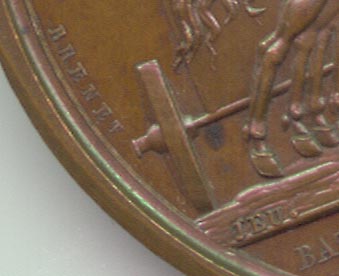
| d'Essling - 1216 Bataille de Sommo Sierra (Brenet, Droz et Jeuffroy). |
|
| Tête de Nap. à dr. | R. L'emp. dans un bige, foudroyant le génie de l'Inquisition. |
| (TN 27.10 - M. 235 - B. 756) Arg et br. 41 mm. | |