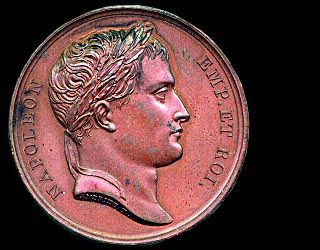
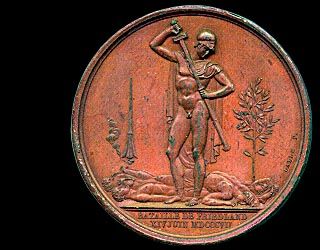
| On the 14th June, the anniversary of the battle of Marengo, the fatal
battle of Friedland was fought between the Russians and the French. On the
morning of that day, Napoleon reminded his troops of their victory at Marengo.
At about half-past five o'clock in the evening of that day, the battle commenced;
Marshal Ney, and General Marchand advanced, and General Bisson's division
supported their left. The Russians attempted to turn Marshal Ney with several
regiments of cavalry, preceded by a numerous body of cossacks; but General
La Tour Maubeuge immediately formed his division of dragoons, and advancing
to the right in full gallop, repelled their charge. In the mean while, General
Victor ordered a battery of thirty pieces of artillery to be placed in the
front of his centre; and General Summermont having caused it to be moved
about 400 paces forward, the Russians sustained a dreadful loss from its
fire. The different movements which they made to effect a diversion were
useless: several columns of the Russian infantry attacked the right of Marshal
Ney's division, but were charged with the bayonet, and driven into the Alle;
where several thousands perished in a watery grave. While Marshal Ney advanced
to the ravine, which surrounds the town of Friedland, the Russian imperial
guards made an impetuous attack on his left. This corps was for a moment
shaken; but General Dupont's division, which formed the right of the reserve,
marched against the guards, and routed them with a dreadful carnage. The
Russians than drew several reinforcements from their centre and other corps
of reserve, to defend Friedland; but in spite of their efforts, the town
was forced, and the streets covered with dead. At this moment, the centre
of the French, commanded by Marshal Lasnes, was attacked; but the Russians
could make no impression. This sanguinary contest was chiefly decided by
the bayonet; and the result of the day was the total defeat of the Russians.
The carnage was dreadful: according to the French Bulletins, the Russians
left from 15 to 18,000 dead on the field. In this disastrous battle and
retreat, the Russians lost a great part of their artillery, and almost all
their magazines and ammunition on a line of 120 miles in extent. And the
battle of Friedland was not less decisive than those of Austerlitz and Jena,
nor its consequences less fatal to the independence of Europe. |