|
When the campaign was opened on the Rhine, the army of reserve began
its march from Dijon; the government announced it to be at that time 50,000
strong, and receiving reinforcements every day. The chief Consul arrived
at Dijon and reviewed the army. He promised his troops at Dijon, that
in two decades he would lead them to Milan. He performed his journey from
Paris to Dijon in twenty-five hours, and immediately sent an account of
his arrival to the second and third Consuls at Paris. Before the allies
even knew of his departure he was in the Valais, at the house of convalescence,
belonging to the Monks of St. Bernard, there he continued three days,
and made himself acquainted with all the local obstacles that he had to
surmount.
|
| |
| From mount St. Bernard the army began to meet with difficulties, which
might have been thought insurmountable, but enthusiasm conquered them all.
They had to draw their artillery along narrow paths, in many places almost
perpendicular; and other mountains of snow; a very small force would have
arrested their progress, but they met no opposition. |
| |
| They reached St. Peter near the great mountain St. Bernard, on the 15th
May, General Berthier acting as Bonaparte's lieutenant. The whole park of
artillery was collected there. The mountain they had to pass was over 1800
feet above the level of the sea; all wild and barren, a vast extent of snow
and ice, mingled with a terrific silence. Over this frightful mountain the
mind of Bonaparte conceived the possibility of passing his army with all
its artillery, baggage &c. Obstacles almost invincible presented themselves,
but all was foreseen by the genius who conceived the enterprise, and contrived
every thing to carry it into execution. |
| |
| The cannon, caissons, forges, &c. were immediately dismounted piece-meal;
a number of trees were hollowed like troughs, in which the pieces of cannons
might safely slide, and five or six hundred men drew them up these tremendous
heights; the wheels were carried on poles; sledges conveyed the axle-trees;
and empty caissons and mules were loaded with the ammunition boxes made
of fir. |
| |
| The Consul took no more baggage than was absolutely necessary. It took
five hours to climb as high as the Monastery of the Bernardines, where every
individual was refreshed by a glass of wine; this though frozen, was to
them delicious, and no one would have exchanged it for all the gold of Peru.
There were still six leagues to go, and the rapidity of the descent made
that distance truly terrible; men and horses constantly falling, and often
recovering with the greatest difficulty. |
| |
| Bonaparte entered the Monastery, and staid about an hour; and on leaving
it, exhorted these respectable hermits to continue to deserve well of humanity.
His mules and horses were in the train; he entered a path which some infantry
pursued, the descent was so steep, that he was forced to slide down above
two hundred feet on his derriere end, and was nearly swallowed up by coming
into contact with a collection of thawed snow; the holes into which the
soldiers constantly fell, made this part of the journey worse than the ascending,
the march commenced at midnight, and did not finish till about nine o'clock
the next evening; for near fourteen leagues the army had scarcely had a
meal, or any repose, yet at the end of the journey, exhausted nature so
overcame even the most robust amongst them, that they quietly resigned themselves
into the arms of Morpheus, without ever thinking of their evening repast. |
| |
| Before their Consul ascended the mountain steep, he addressed a letter
to his brother Lucien, then minister of the interior, which reached Paris
on the 23rd of May. He then stated, that he was at the foot of the great
Alps, in the midst of the Valais. The great St. Bernard offered many obstacles,
but they are surmounted; the army is descending by forced marches, and in
three days all will be over. |
| |
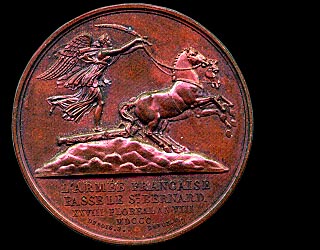
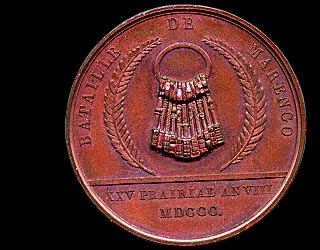
Bramsen - 37
Passage du Saint-Bernhard |
| La Victoire sur un canon placé sur un traîneau
auquel sont attelés deux chevaux qu'elle dirige sur le sommet d'une
montagne escarpée. |
Rev: BATAILLE DE MARENGO. Onze clefs suspendues à
un anneau: de chaque côté, une palme. |
| Exergue: L'ARMÉE FRANÇAISE PASSE LE ST.
BERNARD, XXVIII FLOREAL, AN VIII. MDCCC. DUBOIS F. DENON D. |
Exergue: XXV PRAIRIAL, AN VIII. MDCCC. |
| Médaille 41 mm. - T.N. 76, 9; H. m. 7,
23; M.F. 322, 69. |
| Par la convention d'Alexandrie,
le 15 juin 1800, deux jours après la bataille de Marengo, signée
entre Berthier et Melas, 12 chateaux (et non pas 11) furent remis aux troupes
françaises. |