Back
Back

Great Britain - 1820

The Elgin Marbles

Obverse
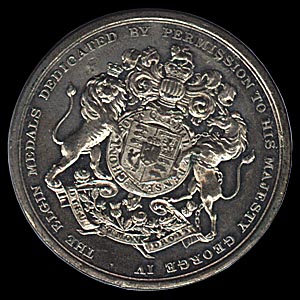
Obverse:
The Royal Coat of Arms with supporters.
Legend:
THE ELGIN MEDALS DEDICATED BY PERMISSION TO HIS MAJESTY GEORGE IV.
Size:
48 mm.
Reverse
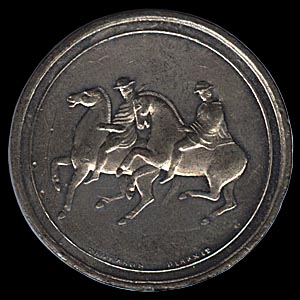
Reverse:
A fragment from the frieze of the marbles.
Vern's Comments:

This example is in white metal, which probably means that it is a later restrike. This is one of those medals that has, at best, a tenuous connection to the Napoleonic era. It is typical of the period however that these marbles were essentially looted from the Greeks, probably for not much more than a bribe.

Wikipedia has a more complete story to tell.

BHM:

AE 48 published by E. Thomason.
AE N.

 
The set of medals consists of 48 pieces which were issued in five folio size leather bound books; there is also an accompanying descriptive book. Individual medals are quite frequently found but a complete set in extremely fine condition together with the descriptive book may be described as very rare. Sets in Morocco cases were given to King George IV and the Czar of Russia.
  The Elgin marbles derived chiefly from the Parthenon, the temple of Athene on the Acropolis of Athens, of which they formed part of the frieze and pediment. They were the work of Phidias under the government of Pericles about 440 B.C. Thomas, Lord Elgin, began the collection of these marbles during his mission to the Ottoman Porte in 1802; the collection was purchased by the British government for £35,000 and placed in the British Museum in 1816. The ship conveying the marbles was wrecked near Cerigo but some months later they were recovered from the sea.
from British Historical Medals, Volume I, p. 261