Back
Back

Great Britain - 1801

Major General Hutchinson and the Delivery of Egypt
Obverse
Obverse:
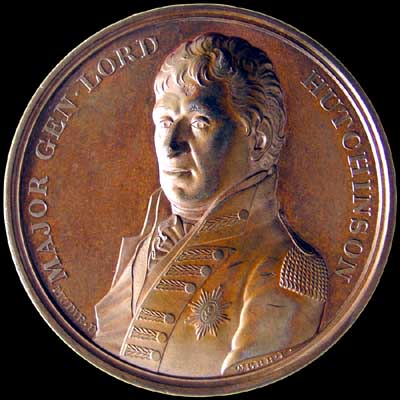
Uniformed bust of Lord John Hely Hutchinson, left. MAJOR GEN. LORD HUTCHINSON
Size:
41 mm.
Reverse
Reverse:
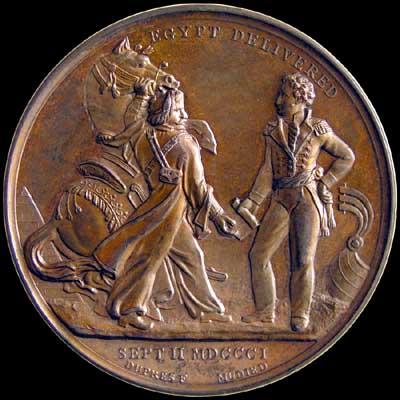
Major-General Hutchinson and the Bey of Egypt holding his horse, concluding the Treaty prior to the departure of the British troops. Pyramid and ship's prow in the background. EGYPT DELIVERED
Exergue:
SEPT II MDCCCI

Mudie:

Mudie - IX.
EGYPT DELIVERED.
   JOHN HELY HUTCHINSON, Lord Hutchinson, Baron of Alexandria, was born on the 15th May 1757. He is the second son of Christiana, baroness of Donoughmore, by the late Right Hon. John Hely Hutchinson, principal Secretary of State for Ireland, and keeper of His Majesty's signet or privy seal. This gentleman was a conspicuous political character in Ireland, during the latter half of the last century.
   Lord Hutchinson, who is next brother to the present Earl of Donoughmore, was educated at Eton College, and the University of Dublin. He entered very early in life into the military service of his country, and as he devoted himself with much ardour to its duties, his promotion, aided by the influence of his family, was consequently rapid.
   When the British army, under the lamented Sir Ralph Abercromby was sent to the shores of Egypt, he was appointed second in command, and upon the death of Sir Ralph, in the memorable battle of Aboukir, the chief command of the troops necessarily devolved upon him. It was on this occasion that he displayed those great military talents, whose successful exertion obtained for him a title. Under his authority the capitulation of Cairo took place on the 17th June 1801, which was followed by the surrender of Alexandria, and the final evacuation of Egypt by the French. In reward for these distinguished services, General Hutchinson was advanced to the dignity of a British peerage, and on the 16th of December 1801, received the unanimous thanks of both Houses of Parliament, and a pension of £ 2,000 per annum.
   The capitulation by which Egypt was entirely freed from the presence of the French armies, was signed on the 31st of August 1801. General Menou found it impossible to maintain himself in Alexandria any longer, against the combined land and sea forces of the British, by which that city was blockaded; and on the 30th of August at two o'clock in the afternoon one of his aid-de-camps arrived at General Hutchinson's head quarters with the proposed terms of surrender. Some of these terms, however, were so ridiculous and absurd, that they were peremptorily rejected, and an answer returned that the armistice would be annulled, and hostilities immediately recommenced if Menou did not consider better of his demands. Amended articles of capitulation were then proposed on the 31st, and being acceded to with some explanatory additions on the part of General Hutchinson, the British army took possession of the French lines at 12 o'clock on the 2nd of September. The victorious troops marched in with all the bands playing aud drums beating, and the British and Turkish flags were immediately hoisted together. Thus was a glorious campaign terminated, by giving us the entire possession of Egypt, and an enemy, who during the war had considered himself invincible, was taught that British troops meeting him on fair ground, knew how to maintain their ancient superiority.
DESCRIPTION OF THE MEDAL.
Obverse. - A three quarter bust of Lord Hutchinson, in his regimentals, by Webb.
Reverse. - General Hutchinson and the Bey of Egypt concluding their final treaty, previously to the departure of the British force which had expelled the French from that country.
Scan from Mudie's book...

Bramsen:

Bramsen - 2161
Capitulation des Français en Egypte.
(Webb et Duprés.)
MAJOR GEN. LORD HUTCHINSON. Buste de trois quarts, à gauche. en uniforme.
Rev: En haut: EGYPT DELIVERED. Le général Lord Hutchinson et le Bey de l'Egypte, ce dernier tenant de la main gauche un cheval forcené, échangent le traité d'alliance avec l'Angleterre.
Exergue: SEPT II MDCCCI.
Médaille, 41 mm. - Mudie IX.

BHM:

AR, AE, WM 41 by T. Webb & A. Dupré.
AR R; AE N; WM R.
AM; BMAG; HC; HL.
E.P.M. 1892/321; M. 9.
 
John Hely Hutchinson (1757-1832), first Baron Hutchinson, afterwards second Earl of Donoughmore. Educated at Eton and Dublin, he entered the army in 1774 and served in France and Flanders. He commanded the first division under Abercromby in Egypt and was his second-in-command.
   Upon Abercromby's death the chief command fell to Hutchinson and it was under him that the English troops forced the French to evacuate Egypt. The reverse of this medal refers to the surrender of Alexandria on the 2nd September 1801 and the redress which Hutchinson obtained for the Bey of Egypt. Hutchinson was raised to the peerage as a reward for his services in this Campaign. Under Article XVI of the Treaty the British received all antiquities collected by the French, including the Rosetta Stone, now in the British Museum.
   One of the Mudie's series of National medals (see No. 1057) issued in 1820. Examples of this medal occur in white metal and are probably restrikes and were not included in the series. Specimens of this medal are believed to have been struck in gold but no example has been met with.
from British Historical Medals, Volume 1, p. 125

Major General Hutchinson and the Delivery of Egypt

obverse

Major General Hutchinson and the Delivery of Egypt

Click to dismiss