Back
Back

Great Britain - 1802

The Prince of Wales, Grand Master of the Freemasons and the Duke of Clarence
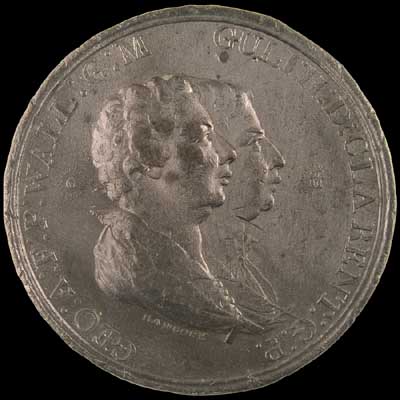
Obverse
Obverse:
Conjoined draped bust of the Prince of Wales and the Duke of Clarence, bare head right. GEO : A: F : WALL : G : M : GULI : H : D : CLARENT : G : P. (George Augustus Frederick, [Prince of] Wales, Grand Master, William Henry Duke of Clarence, Grand President)
Size:
42 mm.
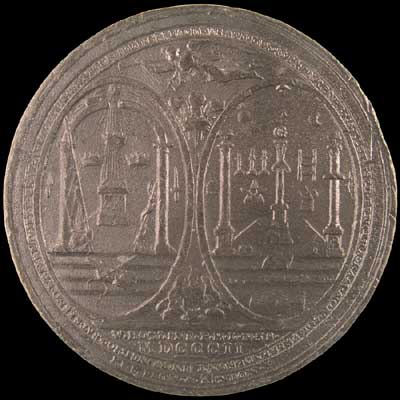
Reverse
Reverse:
Various symbols within two oval medallions divided by the Prince of Wales Plumes and the arms of the Duke of Clarence, Fame flying above.
Legend:
W . HOLLINS . P . M . L . N . 38 . / MDCCCII

Vern's Comments:

The reverse has a narrow border which reads: IN . PRINCIPO . ERAT . SERMO . ET . SERMO . ILLE . ERAT . APUD . DEUM . ERATQUE . ILLE . SERMO . DEUS; ET . LUX . ISTA . IN . TENEBRIS . LUCIT . SED . TENEBRAE . EAM . NON . COMPREHENDERUNT.
(In the beginning was the Word and that Word was with God and that Word was God. And that light shines in the darkness but the darkness has not understood it).

Marvin:

Marvin - CCLXII.
Obverse. Accolated busts to right of George, Prince of Wales, and William, Duke of Clarence: the former wearing a collar with the square, and the latter, one with two interlaced triangles, forming a star of six points; in the field, on the left, the radiant letter G and on the right, the triple tau, also in rays.

Reverse. Two oval tablets side by side; in that on the left, an unfinished arch supported by two pillars, the rays of the meridian sun darting through the space where the keystone should be, and falling on an altar of three steps; on the front of the altar is a pointed star, and on its top a triangle; above are three crowns; on the right, leaning against the pillar, is a rod entwined with a serpent, and on the left a long staff, with a banner or curtain; on the left of the left pillar is a trowel, and on the right of the other a dagger; the altar stands on a mosaic pavement; on the steps in front of the pavement are a spade, bar, pick, and cord. In the other tablet are three pillars, the centre one having G on its capital and a square hanging in front; the right has a level in front, and B on its base; the left has a plumb and J on the base; the capital of each side pillar is sur­mounted by a globe; between the pillars is a mosaic pavement, with the rough and perfect ashlars in the foreground, and a trestle board in the centre three steps, on which are lying the Bible, square and compasses approach the pavement, in front of which is a coffin and the emblems of mortality: over the centre pillar is a cluster of seven stars, and above, the All-seeing eye in clouds, on the left of this pillar, three small burning tapers, adorned with the plumb, square and level; below them is a five-pointed star, and above them the radiant sun; on the right of this pillar a ladder of three steps, below which is the forty-seventh problem of Euclid, and above which the crescent moon: on the right of the right pillar, a sprig of acacia, and on the left of the left, an apron (?) Between the two tablets, above, are the coronet and three feathers of the Prince of Wales, and below, on a square, the arms, crest, and supporters (beavers) of the Grand Lodge of “Modern" Masons, so called, as described under obverse of LXII.

Legend, GEO: A: F: P: WALL: G: M: GULI: H: D: CLARENT: G : P: O. In exergue, W. HOLLINS, P. M. L. N. 38. M.D.CCC.II in two lines.
Below* the busts, HANCOCK. Legend, in very small letters, IN. PRINCIPIO. ERAT. SERMO. ET. SERMO. ILLE. ERAT. APUD. DEUM. ERATQUE. ILLE. SERMO. DEUS: ET. LUX. ISTA. IN. TENEBRIS. L UCIT. ET. TENEBRAE. .EAM. NON. COMPREHENDERUNT. [In the beginning was the Word, and the Word was with God, and the Word was God: and the light shineth in darkness, but the darkness comprehended it not]
At the bottom outside the legend. KEMPSON ET KINDON F.
Bronze, white metal, and probably others. Size 27.
This very elaborate Medal, one of the finest I have seen of English Masonics, is said by Merzdorf to have been struck in 1802 on the occasion of the union of the two rites (Royal Arch Masonry with the" Blue" Lodge degrees.) in England**. The arrangement of the emblems in the tablet on the right is very similar to that on XXXVII...

* I read the abbreviations translated from the Latin, as signifying George Augustus Frederic, Prince of Wales, Grand Master: William Henry, Duke of Clarence, Grand Principal of the Order. (The three officers at the head of a Royal Arch Chapter in England are styled Principals.) The first-named was afterwards George the Fourth, and the other (his brother) William the Fourth of England. The letters after the name in the exergue (reverse) I take to mean “Past Master Lodge No. 38.”

** The Royal Arch Degree was recognized by the English Grand Lodge after the union in 1813, and the Grand Master of the United Grand Lodge made ex officio “Grand Principal Z." The rite may have been recognized, as Merzdorf says, before the union, by the "Moderns," but I have not as yet been able to verify that statement. My description is from a foil rubbing, kindly furnished me by Mr. Proskey of New York.

BHM:

This medal was probably issued in commemoration of a 'grand entertainment' given in the Mansion House by the Lord Mayor of London for the Prince of Wales, Grand Master, the Duke of Clarence and the Britannic Lodge of Freemasons. See the Gentleman's Magazine, 1802, p. 575. It was issued by W. Hollins, a Past Master of St Paul's Lodge, Birmingham. The inscription on the reverse of this piece is an adaptation of St John's Gospel, I v. 1 and 5. The Vulgate text is considerably different.
from British Historical Medals, pp. 129-130
 

The Prince of Wales, Grand Master of the Freemasons and the Duke of Clarence

obverse

The Prince of Wales, Grand Master of the Freemasons and the Duke of Clarence

Click to dismiss