Back
Back

Great Britain - 1810

Imprisonment of Sir Francis Burdett - 4th
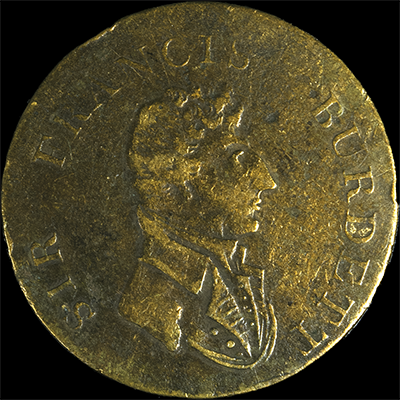
Obverse
Obverse:
Draped bust of Sir Francis Burdett, bare head right.
Legend:
SIR FRANCIS BURDETT
Size:
24.8 mm.
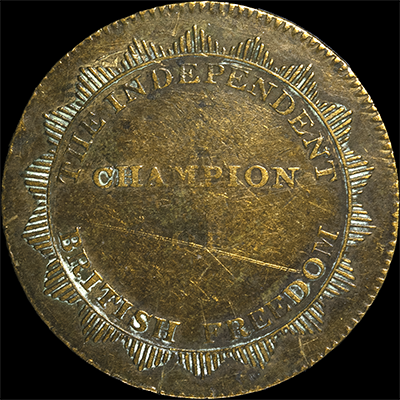
Reverse
Reverse:
Inscription within circle of rays THE INDEPENDENT / CHAMPION / OF / BRITISH FREEDOM

Vern's Comments:

Not all Britons fully endorsed the actions of Sir Francis. Many were concerned that these actions were indirectly aiding Napoleon or were the precursor to Revolution in Britain like the one that changed the face of France. An acute observer of the period was Joseph Farington whose diaries make interesting reading. Following are some extracts from his thoughts about Burdett and this incident ending with Sir Francis' release:

May 10, 1809:
He sd. Sir Francis is a learned man - a good scholar, & has an unmoved temper. - He thinks it to be His duty to do what He does as a public man.

May 13, 1809:
The Revd. Mr. Bowles spoke of Sir F. Burdett as being very profligate in His moral principles, having, as a Lady told Mr. Bowles, done all in His power to corrupt Her principles by laughing at notions of Chastity as prejudices. Also that He is very tyrannical where He has power; viz: over His tenants &c. I spoke of the favorable acct. I had heard of His domestic & moral character. Mr Bowles believed He was so in His family. Mr. S. Bourne spoke of Sir Francis having carried Bribery at the Election for Middlesex farther than any other man had done. Sir George thought Him a man influenced by ambition & Vanity, and that He wd. be indifferent to any danger He might cause provided it obtained for Him to be carried round Covent Garden on men's shoulders.

June 14, 1809:
Mr. Long sd. to me that Sir Francis Burdett speaks in the House of Commons with great fluency, but does not speak so well in reply as in those speeches which He delivers on a subject on which He has prepared Himself.

April 5, 1810:
This day in the House of Commons, the adjourned debate upon the charge against Sir Francis Burdett for a libellous publication affecting the character & privileges of the House of Commons took place. Resolutions moved by Mr. Lethbridge Member for Somersetshire, declaring Sir Francis' publication to be a Libel on the House of Commons & its privileges were agreed to, after which Sir Robert Salusbury [M.P.] moved that Sir Francis Burdett be committed to the Tower... The motion for committing Sir F. Burdett to the Tower was then carried witht. a division and the House adjourned at ½ past 7 oClock.

April 7, 1810:
Mr. A. Phipps came in, & had just seen Sir Francis Burdett riding abroad as usual notwithstanding the vote of the House of Commons on Thursday last to commit Him to the Tower. He understood that Sir Francis had written to the Speaker, stating, that as He considered this vote to be illegal, He wd. not submit to be taken up by the Serjeant at Arms, but if they should think it proper to send an armed force He would surrender Himself to it. Further, He had understood that if a reprimand by the Speaker had only been voted, Sir Francis had resolved to reply to to Him. Mr. Canning's encomium on the talents of Sir Francis was spoken of & thought injudicious.

April 8, 1810:
On my way to St. James's Chapel I met the Revd. Mr. Matthew, who told me His Son, Dr. Matthew, a Member of the Corps of St. James's Volunteers, had been out with His Corps, 4 or 500 during the night, till 5 oClock this morning, to prevent riots in the streets, by people assembled in favour of Sir Francis Burdett; that several shots had been fired upon the regular soldiers who were parading the streets, & that one of them had been killed. Mr. Matthew thought it wd. be prudent for the inhabitants of our district to meet & to form a plan for guarding our Houses. l told Him I had no apprehension for any but political men. --- Bishop of Salisbury's I dined at. We talked of the agitated state of the town in consequence of the vote for committing Sir Francis Burdett to the Tower.

April 9, 1810:
Sir George Beaumont called. Lord Arden had told Him that Sir F. Burdett had been taken this forenoon to the Tower by an armed force. They were obliged to break into His House, as He wd. not have His doors opened to them.-Sir George thought the Government had not acted judiciously, in not having better concerted their measures & not having acted with more promptness & decision. The vote of the House of Commons must be supported, therefore, it shd. have been done, & the propriety of their proceedings might have been afterwards settled.

April 10, 1810:
Lawrence called in the even'g. He thought Sir Francis Burdett had by His letter to the Speaker of the House of Commons completely done away all the grounds which He could hope to be popular.
In the House of Commons this day the letter of Sir Francis Burdett to the Speaker was taken into consideration, and after a long discussion, it was Resolved, Nemine Contradicente, "That the letter was a high and flagrant breach of the privileges of that House; but, as it appeared from the evidence of the Serjeant at Arms, that the order of the House had been executed, the House did not think it proper to proceed farther," The Honble. Mr. Lyttleton sd. "Among the grounds of complaint He had against the Honble. Baronet He cd. not pass over His implied promise to the Serjeant at Arms to accompany him to the Tower. He had lived on terms of friendship with that Honble. Baronet; but this was an act so wholly unworthy of him, that He must for ever abjure him either as a private or a political friend."

April 17, 1810:
This day a large body of the Electors of Westminster assembled by advertisement, met in Palace Yard, & unanimously voted a strong Petition to the House of Commons against the seizing & imprisoning Sir Francis Burdett, one of their Members; also a letter to Sir Francis Burdett warmly approving the whole of His political conduct. In the even'g the Petition was presented to the House of Commons and was ordered to lie on the table.

May 14, 1810:
Calcott called to-day. He spoke of the times as being very alarming. The people now cheer the Foot-guards, and insult & attack the Horse-guards, since the riots caused by Sir F. Burdett's commitment.

June 21, 1810:
I walked to the Academy & saw the Strand crowded with people & the windows filled with Spectators waiting to see Sir Francis Burdett brought in procession from the Tower. Lawrence I dined with. He had been to the Tower with Lysons & saw Lord Moira take leave of Sir Francis Burdett, the Parliament having been this afternoon prorogued. A vast cavalcade had assembled on Tower Hill, waiting to attend Sir Francis in procession, but He covered with a great Coat, walked to the Tower stairs & got into a Boat to go home by water ; to the great disappointment of the people.


BHM:

AE, AE silvered, 26 by ?
AE N; AE silvered RR.
AM; BM; ML.

 
This medal probably refers to the many acts of Burdett in defence of public liberties and especially to his defense of John Gale Jones, who was imprisoned for raising a discussion upon the practice of the House as to the exclusion of strangers. See also note to No. 422.
from British Historical Medals, Volume 1, p. 169


Imprisonment of Sir Francis Burdett - 4th

obverse

Imprisonment of Sir Francis Burdett - 4th

Click to dismiss