Back
Back

France - 1811

The Lines of Torres Vedras and the English Army on the Tagus - 2nd
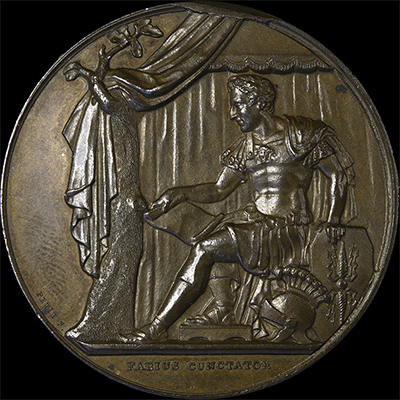
Obverse
Obverse:
The Duke of Wellington, in the guise of a Roman general seated before his tent.
Exergue:
FABIUS CUNCTATOR (The Delayer).
Size:
41 mm.
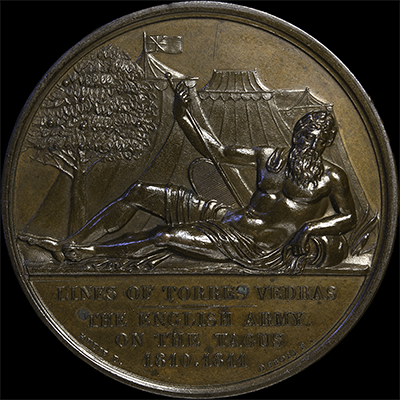
Reverse
Reverse:
River god reclining before English tents.
Exergue:
LINES OF TORRES VEDRAS / THE ENGLISH ARMY / ON THE TAGUS / 1810 . 1811

Vern's Comments:

Eimer:

1016 English Army on the Tagus 1811 Obv. Duke of Wellington, as a Roman general, seated, l. Ex. FABIUS CUNCTATOR Rev. River god reclining, before English tents. Ex. LINES OF TORRES VEDRAS THE ENGLISH ARMY ON THE TAGUS 1810 . 1811 D. 41 mm. By L.M. Petit/E.J. Dubois. BHM 713; Bramsen 1138; Mudie 17
Struck in 1820, from Mudie's series commemorating British victories. See No. 1136.

Mudie:

TORRES VEDRAS.

Scan from Mudie...
   WHEN Lord We1lington fell back after the battle of Busaco ( which was fought on the 27th September 1810), followed by the enemy in great force, he adopted a plan for securing his own army, and harassing the hostile one, which, however it might ·he lamented on the score of humanity, was admirably conceived; as a military stratagem. The greater part of the inhabitants in the different place~ through which the allied forces passed accompanied them in their retreat; carrying with them, at the same time, as much of private wealth as they could remove. All that remained which could he of the smallest use to the invaders was entirely destroyed, and the whole country rendered a barren and unproductive desert. Massena and his army soon began to feel. the effects of this lamentable, but necessary desolation. In an intercepted letter to Berthier;, he said, "the enemy burns and destroys every thing as he evacuates the country. He forces the inhabitants to abandon their houses on pain of death. Coimbra, a town of 20,000 inhabitants, is deserted. We find no provisions. The army is subsisted on Indian corn and vegetables which we find remaining on the ground." This picture was not overcharged; - every soul in Coimbra fled, leaving it literally a desert. The orders of the regency, indeed, were positive, for all to leave their houses, carry off all their goods or destroy them, and suffer nothing to fall into the hands of the enemy. The distress and misery that followed defy description ;- weeping mothers were seen hurrying along with their screaming infants; young and interesting females, also bathed in tears, formed part of the melancholy procession; while the men, old and young, some vowing eternal vengeance against their ruthless destroyers, - others, wrapped in silent anguish at the total loss and ruin of all they possessed, mingled their execrations and signs with the tears and wailings of the women and children.
    Buonaparte, incensed at a measure which so materially embarrassed the operations of his army, issued an acrimonious attack upon it in the "Moniteur." He was compelled, however, to applaud what he affected to condemn for its inhumanity. "The obstacles which the army of Portugal has met with," said he, "arise from an inactive system of defence, profoundly combined, and which has been carried into execution with a singular degree of barbarity, unknown in our European wars, happily for the honour and humanity of nations." It was amusing to read this burst of sensibility from a man who never suffered his own career to be checked -never for a moment- by any feeling that bore the faintest resemblance to mercy and humanity. The simple fact was, that Buonaparte and his generals had mistaken the character of Wellington. They considered him an ardent, active general in the day of battle, and so eager for fighting, that he did not always calculate his resources and strength. They never once suspected that he was equally prepared, as occasion might serve, to conquer with the rapidity of a Cæsar, or to oppose a Fabian policy, while waiting for the moment of action.
    The object of Lord Wellington in this campaign was, to defend Portugal, and, at the same time, to occupy a considerable French force, which would otherwise have been emp1oyed in Spain. When Massena pursued the allied army after the battle of Busaco, he confidently anticipated that the Britisb were flying to their ships off Lisbon: but when on the 14th October 1810, he arrived in front of the lines of TORRES VEDRAS, and beheld, in person, the fortified position, he found, too late, the fatal error into which he had been betrayed by the superior military genius of Lord Wellington. This grand position of the allied army, in the selecting and fortifying of which Lord Wellington displayed such consummate sagacity, formed a line of strongly defended heights, extending from Alhambra on the Tagus, to Torres Vedras, about thirty miles from Lisbon, and from thence to the mouth of the Sissandro. Behind these were two other lines of trenches and redoubts, extending from Ericeyra and Mafra, on the sea, to the Tagus. One of these, which was next to the fortified line of Torres Vedras, might be defended by 20,000 men; the other, which was nearer Lisbon, by half that numhcr. On these was planted an immense power of henvy artillery ; and besides this triple line, redoubts were raised at Peniche, Obidos, and other places. Many of the hills were fortified. On the left of the position the whole of the coast from Vimiera to the mouth of the Tagus, was studded with redoubts, mounted with heavy artillery. On the right; the banks of the Tagus were flanked by our armed boats. Mines, also, ready to spring, were formed in various places. In short the whole country, from Lisbon almost to the Mondego, appeared like one fortification, in the shape of a crescent. Within the lines of Torres Vedras, Ericeyra, and Mafra; defended by from 70 to 80,000 fighting men, the allies had collected all the produce of the country through which they had retreated. With Lisbon, too, in their rear, they were abundantly supplied with every thing they wanted.
   The sufferings of the French army while they remained before this impregnable position, were of the most appalling character. Yet they endured them for several mopths, and it was not till the 5th March 1811 that Marshal Massena, finding his magazines nearly exhausted, and his foragers meeting with no success, although detached sometimes twenty leagues, broke up with his army, and began his retreat; Lord Wellington immediately put his troops in motion, and closely pursued the enemy, till he had fairly driven them once more beyond the confines of Portugal. Such was the auspicious termination of a plan, which was greatly conceived and inflexibly executed; a plan, too, which in its consequences may be said to have involved the salvation of Europe. It was after Wellington quitted the lines of Torres Vedras, that he commenced his unbroken series of conquests which ceased not till he had planted the flag of England on the soil of imperial France. Had he been compelled to evacuate Portugal, and fly to his ships, who will be bold enough to say, that Europe would have been redeemed from the bondage of Napoleon?

DESCRIPTION OF THE MEDAL.


OBVERSE.- Marshal Wellington, in his tent, and in the dress of a Roman general, meditating on his future operations. He is compared on this classical obverse to the celebrated Roman general Fabius, who, by protracted delay and avoiding to fight, eventually defeated the greatest general of antiquity - Hannibal; and was therefore called Fabius Cunctator, or Fabius the Delayer.
REVERSE.- A personification of the river Tagus, near which was the British army at Torres Vedras, represented by the tents. The orange-tree is a significant indication of Portugal, thus protected by the British.

Bramsen:

1138. Wellington aux lignes de Torres Vedras. (Petit et Dubois.)
Wellington en costume de guerrier romain, assis, à gauche, sous une tente étudiant un rouleau de papier. Exergue: FABIUS CUNCTATOR.
Rev: Le dieu du Tejo, à gauche, en repos et s'appuyant de la main gauche sur une urne. Devant lui un arbre fruitier et au fond plusieurs tentes dont l'une nu deapeau anglais. Exergue: LINES OF TORRES VEDRAS - THE ENGLISH ARMY. ON THE TAGUS 1810. 1811.
Médaille, 41 mm. - Inédite; cabinet de l'autour.

BHM:

AR, AE, WM 41 by J.E. Petit and E. J. Dubois.

AR R; AE N; WM R.
G. 123/546; M. 17.
AM; BMAG; HC.

During the winter of 1809 Wellesley (later Duke of Wellington) had been fortifying a series of lines around Lisbon on the heights of Torres Vedras. Led by Marshal Massena, the French troops numbering 80,000 men advanced across the Spanish frontier. Met by stiff resistance from the Portuguese, the French suffered heavy losses and were forced to dig into winter quarters in a wasted countryside before Torres Vedras. Hunger, sickness and the increasing scarcity of supplies eventually forced the French to retreat into Spain freeing Portugal from Napoleon. The legend on the obverse of this medal draws a simile between Wellesley and Quintus Fabius Maximus Verrucosus who, by his tactics in the Second Punic War, kept Hannibal in check for some time without coming to an engagement.
   One of Mudie's series of National Medals (see No. 1057) issued in 1820. Examples of this medal occur in white metal and are probably restrikes and were not included in the series. This medal is believed to have been struck in gold but no specimen has been met with.

The Lines of Torres Vedras and the English Army on the Tagus - 2nd

obverse

The Lines of Torres Vedras and the English Army on the Tagus - 2nd

Click to dismiss