Back
Back

Great Britain - 1812

The Battle of Salamanca
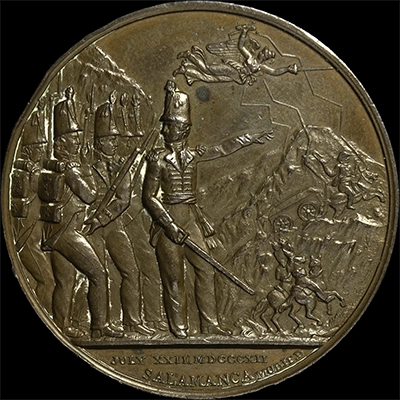
Obverse
Obverse:
British troops preparing to advance against the French deployed in the mountains.
Exergue:
JULY XXII MDCCCXII/ SALAMANCA
Size:
41 mm.
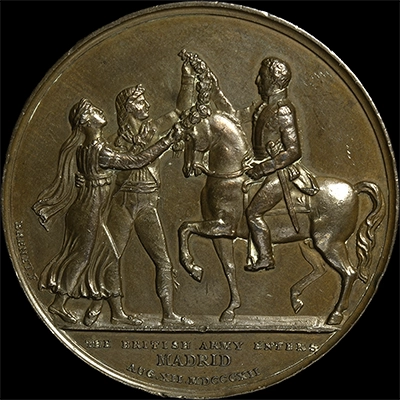
Reverse
Reverse:
Equestrian figure of the Duke of Wellington being garlanded with flowers by two Spaniards.
Legend:
THE BRITISH ARMY ENTERS / MADRID/ AUG XII . MDCCCXII

Vern's Comments:

An unfortunate cleaning at some point I suspect.

Mudie:

No. XXI.

BATTLE OF SALAMANCA.


   THIS memorable conflict took place on the 22nd of July 1812, near the city from which it derives its name. Early on the morning of that day, the British army took up the ground in position, placing its right near the bold rocky heights called the Arapiles, and its left on the Tormes. The enemy were immediately in front, covered by a thick wood. They were commanded by Marshal Marmont.
   About eight A. M. a French column rapidly advanced from this wood, and seized the outer and most extensive of those strong points, upon which the allies took possession of the others as quickly as possible. After a variety of evolutions and movements, Marshal Marmont appeared at last to have determined upon his plan, about two o’clock in the afternoon. Under cover of a very heavy cannonade which, however, did the British but little injury, he extended his left with great shew. This was an attempt to turn the position of the allies, whereby, with a force little superior to theirs, he acted on the circumference of an arc of one third greater extent than their line. Lord Wellington, who was eagerly watching for some false movement of his antagonist, instantly profited by this, and at once determined to become the assailant instead of continuing to act on the defensive.
   He accordingly made the following disposition of this army. The 1st and light division, under Generals Campbell and Alten, were stationed to the left of the Arapiles heights, as the extreme left of the line : the divisions of Generals Cole and Leith were in two lines on the right of that point, with the divisions of Generals Clinton and Hope, and a body of Spaniards under Don Carlos de Espana, in column to support them. Major General Packenham’s division, with a considerable body of cavalry, formed the extreme right. While these movements were in progress, the enemy made several unsuccessful endeavours to possess themselves of the village of Arapiles, situated between the two armies, and occupied by a detachment of the guards. The moment the formation of the army was completed, the attack commenced from the right. Major General Packenham with his division, supported by several squadrons of cavalry, under Major-General D’Urban, moved along a valley at a very quick rate, and crossed the extended left of the enemy almost before they were aware of the attempt. Nearly at the same time, General Cole’s and Leith’s divisions, supported by General Clinton’s and Hope’s, moved forward and attacked them in front, while a Portuguese brigade, under Brigadier-General Pack, advanced against the bold height of the Arapiles. General Packenham’s division, with the cavalry quickly overthrew the left of the French, and constantly bringing up their right, so as to out-flank the points on which they attempted to stand, drove them for a considerable distance from one height to another, and made above 300 prisoners.
   Similar success-attended the operations of Generals Cole and Leith, who were rapidly pursuing their objects along the crest of the enemy’s position, when they were momentarily checked by a body of troops advancing on their left flank from the Arapiles height, which, from its great strength, the Portuguese had been unable to carry. Marshal Beresford, who was on the spot, changed the front of a brigade in reserve, which held in check the troops near the Arapiles till the arrival of General Clinton’s division, when the French abandoned that important point, and the battle again became a series of triumphs. A charge of cavalry made by Sir Stapleton Cotton, in which the “noble officer” (as Lord Wellington termed him in his dispatch) General le Marchant fell, was eminently successful, and all the heights on which the enemy endeavoured to check our pursuit, were immediately carried.
   The only appearance of equal resistance was displayed, for a short time, on the French right, where the fugitives, forced back from their left by the advance of General Packenham, attempted to reform, under protection of the troops which had retired in good order from the Arapiles. An attack in front, made by General Clinton, cost many men; but on a an movement of General Cole, they hastily retired, and the allied troops pursued them till night as quickly as they could march. Never was an army more completely routed. Marshal Marmont and his second being disabled, the command of the French devolved upon General Clausel, who, as soon as it became dark, made a most rapid march to Alba de Tormes. The first and light divisions were ordered to the fort of Huerta, in expectation that the Spaniards would continue to hold the castle of Alba, and that consequently the retreat of the enemy must be by Huerta; but the French having contrived to dislodge the Spaniards from the castle, crossed the Tormes at that spot in the course of the night, and saved themselves from the further considerable loss which must otherwise have ensued. The next morning the main body of the allies advanced to Alba, where the cavalry crossed, and shortly afterwards came up with the rear guard of the fugitives. A brilliant charge was directed against them by General Bock, with a brigade of heavy dragoons of the German legion, in which numbers were sabred, and nine hundred made prisoners. Many others owed their safety to throwing away their arms, and scrambling over the enclosures. Lord Wellington followed the fugitives to Valladolid, which he entered on the 30th, but finding they continued in full retreat on Burgos, and that he had no chance of overtaking them, he re-crossed the Douro the next day.
   The loss of the enemy in this sanguinary conflict was very great. Besides the numbers of dead and wounded, 7,000 prisoners were taken eleven pieces of artillery, two eagles, and six colours. The allies had nearly 5,000 killed and wounded. Among the latter were five general officers, Beresford, Stapleton Cotton, Cole, Leith, and Alten. Sir Stapleton Cotton was unfortunately wounded by one of our own sentinels, after he had halted from the pursuit, owing to the darkness of the night.
   Such was the battle of Salamanca, a battle which may rank with the noblest exploits recorded in history, whether we consider the decisive skill and dauntless energy with which it was fought or the and promptitude that directed its operations. Undoubtedly Marmont committed a great blunder, but even when committed, and even when detected, it required no common portion of sagacity, no common effort of genius, to convert that blunder into the elements of a signal and glorious victory.
   One of the more immediate results of this battle, was the entrance of Lord Wellington into Madrid, on the 12th of August, Joseph and his army having precipitately abandoned the town, by the road of Toledo, on the approach of the allies.

Description of the Medal.


Obverse. — The British armies displayed great courage in dislodging the French, under General Marmont, from their very advantageous positions on the heights. This is described by the British troops about victoriously to pursue the enemy, on whom the Goddess of War is hurling destruction : the back ground represents the Arapile mountains.
Reverse. — Entry of the British into Madrid. It was the result of this battle; the inhabitants are represented honouring the conqueror, the Duke of Wellington, with garlands of flowers.

scan from Mudie...


Bramsen:

1175. Campagnes de Wellington sur la Péninsule. (Brenet et Mudie.)
Wellington à cheval, la tête nue, est reçu par un espagnol et une espagnole qui lui tendent une guirlande de fleurs. Exergue: THE BRITISH ARMY ENTERS MADRID AUG. XII. MDCCCXII.
Rev: Infanterie anglaise dans des montagnes. Exergue: JULY XXII. MDCCCXII. SALAMANCA.
Médaille, 41 mm. - Inédite; empreinte de M. Jos. Hamburger.

BHM:

AR, AE 41 by N. G. A. Brenet.

AR R; AE N.
Fi. 467/8; G. 123/547; M. 21.
AM; HC; ML.

The battle of Salamanca which took place on the 22nd July 1812 was one of the most decisive of the Peninsular War and the first victory on the offensive achieved by Wellington. Marshal Marmont made the mistake of despatching the whole of his left wing to seize the road from Salamanca to Ciudad Rodrigo and while many of his troops were still marching through a thick forest of cork trees, Wellington attacked and separated the whole of the French left wing from the rest of the army. Marmont's division, believing that the British were in retreat, were marching in disorder and upon being attacked by Sir Edward Pakenham were soon put to flight. This victory finally opened the road to Madrid for the Allies: they entered the city on the 12th August 1812.
   One of Mudie's National Medals (see No. 1057) issued in 1820. Examples of this medal are believed to have been struck in gold but no specimen has been met with.
from British Historical Medals, p. 179


The Battle of Salamanca

obverse

The Battle of Salamanca

Click to dismiss