Back
Back

Great Britain - 1814

The English Re-Enter Hanover
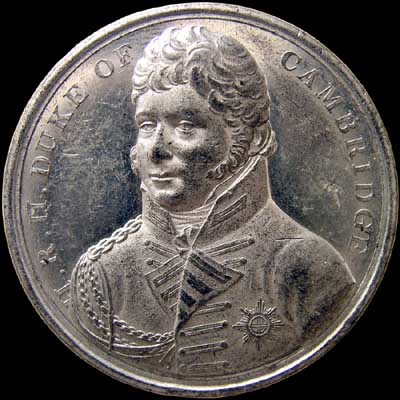
Obverse
Obverse:
Uniformed bust of the Duke of Cambridge, facing.
Legend:
H.R.H. DUKE OF CAMBRIDGE
Size:
41 mm.
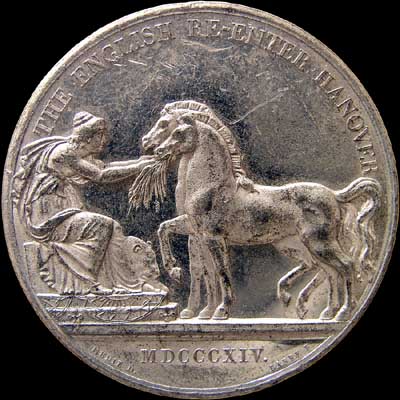
Reverse
Reverse:
Britannia seated feeding two Hanoverian horses.
Legend:
THE ENGLISH RE-ENTER HANOVER.
Exergue:
MDCCCXIV

Vern's Comments:

The d'Essling copy appears to have been a test strike of the reverse only.
I acquired a filler copy of this medal first before getting another one, both copper.
I think this white metal, most likely a later restrike for a collector, is stunning.

Mudie:

Mudie - XXXI.
DUKE OF CAMBRIDGE.
   WHEN the liberation of Germany took place, after the sanguinary and gigantic conflict at Leipsic, the Hanoverian dominions of His Majesty, which had been seized by Buonaparte in 1803, reverted to their former connexion with the crown of Great Britain. The immediate instrument of their deliverance from the yoke of France, was the Crown Prince of Sweden, who after the battle of Leipsic, marched with his army northwards, and on the 6th November 1813 moved his head quarters from Gottingen, where he arrived on the 31st October, to Hanover. His entry was preceded by a proclamation (November 4th) addressed to the Hanoverians, by the two Privy Counsellors Decken and Bremer, announcing the resumption of the government of the Electoral dominions.
   In 1814 His Royal Highness the Duke of Cambridge was appointed Governor General of the Kingdom of Hanover; for to that rank, as a continental state, it had been elevated by His Royal Highness the Prince Regent. On the 24th of October 1814, Count Munster, the Hanoverian Minister of State, delivered a note to the Austrian Minister, and to the Ministers of the other powers assembled at the Congress at Vienna, announcing this change in the royal title of Hanover. In this note, the Prince Regent observed, that the title of Electoral Prince of the Holy Roman Empire was no longer suitable to the actual circumstances of the Germanic States; that several of the principal powers of Germany had, in consequence, invited him to renounce that title, as it would be the means, among other things, of facilitating many of the arrangements which the future welfare of Germany seemed to require; and that therefore, His Royal Highness had resolved, laying aside in the name of his House the Electoral title, to declare that he erected his provinces forming the country of Hanover, into a kingdom, and that he should henceforth assume the title of King of Hanover.
   A proclamation was subsequently issued to the Hanoverians (October 26th), declaring this change, and commanding that in future in all acts, &c. instead of the old titles, they should employ that of "King of the United Kingdoms of Great Britain and Ireland, King of Hanover, Duke of Brunswick and Lunenberg, &c."
   Hanover received some extension of its territories at the Congress of Viena.
   His Royal Highness the Duke of Cambridge has continued, since 1814, in the function of Governor General, and by the wisdom of his political conduct, as well as the amiable influence of his personal character, has conciliated the loyalty and affection of the inhabitants.
DESCRIPTION OF THE MEDAL.
Obverse. - His Royal Highness the Duke of Cambridge.
Reverse. - Entry of the English into Hanover, which is here allegorized by Brittania giving succour to the Hanoverian Horses.
Scan of medal from Mudie's book...

Bramsen:

Bramsen - 1489
Rentrée des Anglais en Hanovre.
(Webb et Barre.)
H. R. H. DUKE OF CAMBRIDGE. Buste, presque de façe, en uniforme.
Rev: THE ENGLISH RE-ENTER HANOVER. Une femme assise, présentant une gerbe d'orge à deux chevaux.
Exergue: MDCCCXIV.
Médaille, 40 mm. - T. N. 63, 8.

d'Essling:

d'Essling - 1527
Rentrée des Anglais à Hanovre.
(Barre.)
Femme ass. présentant une gerbe d'orge à deux chevaux.
(TN. 63. 9). Cuiv. argenté uniface 41 mm.

BHM:

AR, AE, 41 by T. Webb and J. J. Barre.
AR R; AE N.
AM; HC; ML.
E.P.M. 1888/262; Fi. 5678 & 79; M. 31.


Adolphus Frederick, Duke of Cambridge (1774-1850) was the seventh son of George III. He served as a colonel and major-general in the Hanoverian army in the campaign of 1794-95 and in 1803 was appointed Colonel-in-Chief of the King's German Legions, a force in British pay. In 1814, when the French were expelled from Hanover, the Duke took command there and when that state was elevated to the status of a Kingdom by the treaty of Vienna in 1816 the Duke was appointed Viceroy. In 1818 the Duke married Princess Augusta, third daughter of Frederick of Hesse-Cassel.

One of Mudie's National Medals (see No. 1057) issued in 1820. Examples of this medal are believed to have been struck in gold but no specimen has been met with.

from British Historical Medals, Volume 1, p. 187