Back
Back

France - 1801

Paix de Lunéville - variant
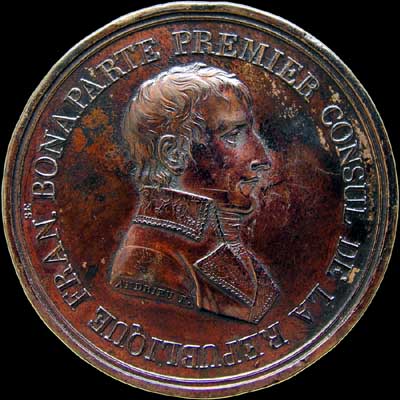
Obverse
Obverse:
Bust of Bonaparte.
Legend:
BONAPARTE PREMIER CONSUL DE LA RÉPUBLIQUE FRANSE.
Exergue:
On the base of the bust, the artist's name, ANDRIEU F.
Size:
42 mm.
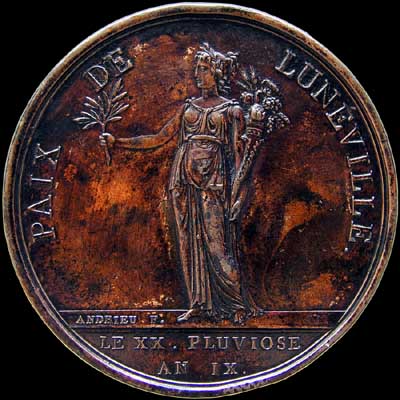
Reverse
Reverse:
an elegant female figure emblematic of peace, she holds in her right hand, which is extended, an olive branch, in her left a cornucopia filled with fruit and wheat ears, her hair and costume is à la grecque, with a laurel wreath round the head.
Legend:
PAIX DE LUNÉVILLE. On the ground whereon she stands, ANDRIEU F.
Exergue:
LE XX. PLUVIOSE, AN IX.

Vern's Comments:

There were three nearly identical medals whose only difference lay in where the legend on the obverse started. Since there's no way of knowing from Laskey's narrative where the legend began I've included this as a variant of XXI.

Laskey:

After several armistices had been entered into between Austria and the French Republic, and as often suffered to expire from the jarring interests of the different powers, Austria at length found it necessary to enter into a treaty for peace, separate and alone, which after many delays, was definitively agreed upon between the first Consul of the French Republic and the Emperor. This treaty was concluded at Luneville, in February, 1801. The plenipotentiaries named, were the Count Cobentzel and Joseph Bonaparte. It agreed, first, that there was to be a permanent peace between the French Republic and the Emperor; the Belgic provinces, Falkenstein and its dependencies; the Frickthal, and all that belongs to the house of Austria on the left bank of the Rhine, between Zurzach and Basle, to be given up to the French. Istria, Dalmatia, and the Venetian Isles dependant on those countries; the Bocca di Cattaro, the city of Venice, the Adriatic sea, and the Adige from its leaving the Tyrol to the mouth of the said sea, to belong to the Emperor, the towing path of the Adige, being the line of limitation. Draw-bridges to be established in the middle of the cities of Verona and Porto Legnano, to mark the separation of this line; the Brisgau to be given to the Duke of Modena; Tuscany and the Island of Elba to be possessed by the infant Duke of Parma; the grand Duke to obtain a full indemnity in Germany for his Italian States; the French to possess all on the left bank of the Rhine, the towing path of the Rhine to be the limit between the French Republic and the Germanic Empire, from where the Rhine leaves Switzerland till it enters the Batavian territory. The French Republic renounces all possession on the right bank of the Rhine, and restores Dusseldorff, Ehrenbreitstein, Phillipsburg, the Fort of Cassel, the Fort of Khel, and Old Brisach; these places to remain as they now are, the Emperor to give indemnity to the hereditary princes dispossessed on the left bank of the Rhine; which shall be taken from all the Empire according to arrangements to be determined on, when the ratification is exchanged; sequestration of property to be taken off on both sides; this treaty to be common to the Batavian, Helvetic, Cisalpine and Ligurian Republics; the said Republics to be gauranteed by both parties.

There were a few other articles, but of no great consequence, and thus, after a war which lasted for near ten years this famous treaty ended.


Bramsen:

Bramsen - 108
Paix de Lunéville
(Andrieu).

Comme celui de la précédente, seulement la légende commence derrière la tête de Napoléon.
Rev: Comme celui de la précédente.
Médaille, 42 mm. T.N. 82, 4, note.

d'Essling:

d'Essling - 881
Paix de Lunéville
(Andrieu).
Variété. La légende commençant derrière le buste à g.
Arg. 42 mm.

Paix de Lunéville - variant

obverse

Paix de Lunéville - variant

Click to dismiss