Back
Back

England - 1795

Patent Boots & Shoes
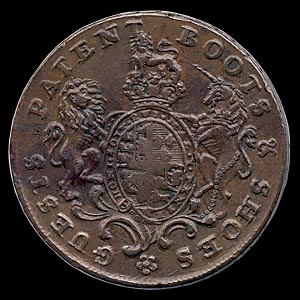
Obverse
Obverse:
The Royal Arms, Crest, and Supporters of England. Arms (Quarterly :-First, Gules, three lions passant gardant, in pale, or, for ENGLAND : impaling, or, a lion rampant gules, within a double tressure flory, counter flory, of the last, for SCOTLAND : Second, azure, three fleurs-de-lys or, for FRANCE: Third, azure, a harp or, stringed argent, for IRELAND : Fourth, gules, two lions passant gardant, in pale, or, for B
Legend:
GUESTS PATENT BOOTS AND SHOES with an ornamental stop.
Edge:
PAYABLE AT LONDON .+.+.+.+.+.
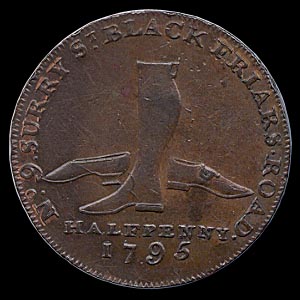
Reverse
Reverse:
A lady's shoe to the left, a man's buckled shoe to the right, and a jack-boot between them.
Legend:
NO. 9. SURRY ST. BLACKFRIARS. ROAD.
Exergue:
and in the exergue, HALFPENNY 1795

Vern's Comments:

Diesinker, Dixon; manufacturer, Lutwyche. Seven cwts. struck. Common.

 
Comments. B. Guest was a boot and shoe maker and wholesale manufacturer of ladies' shoes, who had a business at No.9 Surrey Street, now Blackfriars Road, on the Surrey side of the Thames. It appears that he subsequently became a chemist and invented a preparation styled the "Guestoian Medicine" which he sold from the same address.
 
   The Royal Achievement dates from the time of Richard I, when it was first borne on a shield. After his return from the Crusades he bore the three lions of England. Edward III claimed the French crown in right of his mother and quartered the arms of France with those of England; marshalled thus: Quarterly-First and Fourth, FRANCE; Second and Third, ENGLAND.
 
   The arms of Scotland and Ireland were first regularly marshalled on the shield in the reign of James I., and on the union of Scotland and England in Queen Anne's reign, were impaled in the First and Fourth Quarters; the Second showing FRANCE, and the Third IRELAND.
 
   On the accession of George I the arms of HANOVER were assigned to the Fourth Quarter of the shield, displacing the repetition of England and Scotland, and this was the form of the coat when the token was issued.
 
   The Crowned Lion as a Crest dates from the reign of Edward III and was borne on a Cap of Estate, but is now placed on an Imperial Crown.
 
   The Supporters were probably first used by Richard II and have varied according to the taste of the sovereigns using them.
 
   The Garter owes its origin and motto to Edward III in connection with his claim to the throne of France; Honi soit qui mal y pense (" Dishonour to him who thinks ill of it "). It was adopted for regular armorial use by Henry VIII.
 
   The Motto Dieu et mon Droit was used by Richard I as a battle cry at the siege of Gisors, and adopted as a motto by Henry IV.
 
   Men's shoes of the pattern on the token are said to date from the early part of the seventeenth century, and the buckle from its closing years.
Commercial Coins 1787-1804., pp. 103-105

England — Middlesex

D & H 308 — Guest`s

Bell Pg: 103-105
O:    Royal arms, supporters, and crest. GUESTS PATENT BOOTS & SHOES *
A. 223
R:    A boot, shoe, and lady's slipper. NO. 9 . SURRY ST. BLACK FRIARS ROAD . HALFPENNY 1795.
E:    PAYABLE AT LONDON .+.+.+.+.+.