Back
Back

Scotland - 1797

Anderson, Leslie & Co.
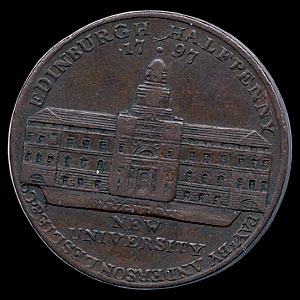
Obverse
Obverse:
The front view of a large building showing the main entrance, dome and vane, with two wings surmounted by pointed pediments; and in a small space beneath the building, WRIGHT DES.
Legend:
EDINBURGH HALFPENNY PAY.E BY ANDERSON LESLIE & CO 1797
Exergue:
NEW UNIVERSITY
Edge:
Plain.
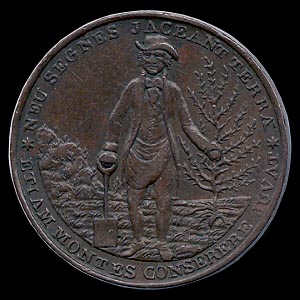
Reverse
Reverse:
View from the front of a gardener wearing a hat and an apron, with an uprooted shrub in his left hand and a spade in his right. A small planted hillock is shown behind him on the left.
Legend:
NEU SEGNES JACEANT TERRÆ * ETIAM MONTES CONSERERE JUVAT *

Vern's Comments:

Diesinker. Wyon; manufacturer, Kempson. Ten cwts. struck. Common.

 
Comments. Anderson. Leslie & Co. were seedsmen, nurserymen and florists in Edinburgh, and hence the appropriateness of the reverse design of a gardener at work.
 
   The obverse shows the University building, which at the time of the token was the largest edifice in Scotland. The University was founded by royal charter in A.D. 1582, and called the College of King James, by the desire of James VI of Scotland. There was only one professor, and he started teaching in A.D. 1583. It was not until A.D. 1720 or A.D. 1721 that anatomy and other branches of medical science began to be taught systematically. Soon the talent of the tutors attracted students from all over the world. Dr. Munro, the anatomist, was also professor of surgery; while Drs. Sinclair, Rutherford, Plumer and Alston, laid the foundation for didactic teaching which gained international recognition.
Detail of Terrae...
 
   On the 16th of November, 1789, the foundation stone of the New College was laid, to replace the old buildings. The plan was a square building with a large central area; the east front having the principal entrance, as shown on the token, adorned with a dome and portico with six large columns. The building contained a hall, library, and museum, and living quarters for the principal and some of the professors; the structure being one of the finest in Europe. Construction at first was rapid, but later came to a standstill for lack of funds, and it remained unfinished for some twenty years. Eventually a government grant enabled the work to be completed about A.D. 1830, a few changes being made in the original plans. The tokens show the building as first designed.
Commercial Coins 1787-1804., pp. 259-260


Scotland — Lothian

D & H 7 — Edinburgh

Bell Pg: 259-260
O:    Very similar to last, but with NEW UNIVERSITY in Ex:
A. 5
R:    Similar to last. Foot over ES.
E:    Plain.