Back
Back

England - 1795

½ Penny - (Kent, Deptford)
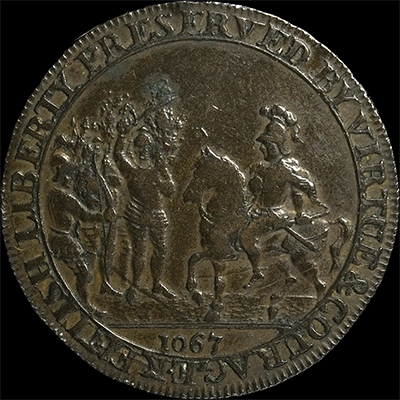
Obverse
Obverse:
The Kentish men meeting William the Conqueror.
Legend:
KENTISH LIBERTY PRESERVED, BY VIRTUE & COURAGE .
Exergue:
1067 below the men.
Size:
28 mm.
Edge:
PAYABLE AT DEPTFORD CHATHAM AND DOVER.
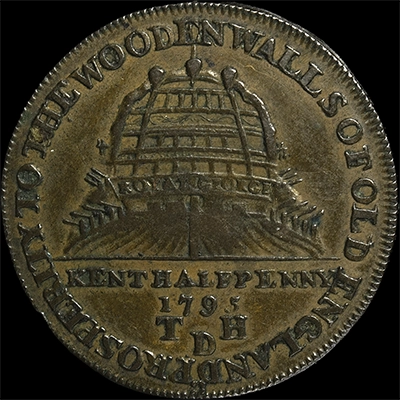
Reverse
Reverse:
The stern of The Royal George from an unusual low angle.
Legend:
PROSPERITY TO THE WOODEN WALLS OF OLD ENGLAND *
Exergue:
Under the hull: KENT HALFPENNY
1795
TDH

Vern's Comments:

BELL No 7 D&H 13

DEPTFORD Haycraft, T.
   Obverse :- An armoured horseman with helmet and plume, bearing in his left hand a truncheon, approaching armed men on foot, one of whom holds up his sword, while another is bending a bow, and two others in the background are partly hidden by tree branches which they are carrying. Legend :-KENTISH LIBERTY PRESERVED BY VIRTUE AND COURAGE with 1067 in the exergue.
   Reverse :- Stern view of the hull of a man-of-war, bearing the ship's name, "Royal George." Legend :- PROSPERITY TO THE WOODEN WALLS OF OLD ENGLAND with an ornamental stop beneath the lettering, and in the exergue, KENT HALFPENNY 1795 below, and below that TDH
   Edges :- (1) PAYABLE AT THO'S HAYCRAFTS DEPTFORD.
                 (2) PAYABLE AT DEPTFORD CHATHAM AND DOVER.
Manufacturer, Mynd. Both edges are common. There are other minor die differences.

Comments. The letters T D H are the initials of the issuer, Thomas Haycraft, who was an ironmonger in Deptford. From the second edge reading he appears to have other businesses in Chatham and Dover, and as these are all ports, and his token shows a ship from a most unusual angle, he may well have dealt in ship accessories, including lanterns which are so prominently displayed on the token. Incidentally, the lanterns on this ship were so large that when they required cleaning a sailor used to get inside.
   The obverse refers to a legend that shortly after the Battle of Hastings, in which the Kentish men formed the vanguard of Harold's army, William entered Kent and was met at Swanscombe by a Kentish force led by the Abbot of St. Augustine's; each man carrying a branch of a tree so that when on the march the force resembled a moving forest, but when they met William they threw aside the branches and showed themselves fully armed: the abbot assured the king that they had come to submit the county to him, but demanded the confirmation of their ancient laws and privileges, which was graciously granted.
   The reverse design recalls the disaster in Portsmouth Harbour in 1782 when The Royal George, commanded by Admiral Kempenfeldt capsized and sank while she was undergoing repairs. Apparently her timbers were infested with dry rot and her bottom literally dropped out. She sank in a few minutes with the loss of eight hundred people, including many women and children who were visiting the ship. Cowper's poem, "The loss of The Royal George," commemorates the disaster. There is a painting of the incident in the Royal United Services Institution, London.
   The 108-gun vessel depicted on the token is the successor to Kempenfeldt's ill-fated ship.

England — Kent

D & H 13a — Deptford

Bell Pg: 67-68
O:    The Kentish men meeting William the Conqueror. KENTISH LIBERTY PRESERVED, &c.
A. 12a
R:    Similar, but centre lamp touches E, and water-line extends almost to T and D.
E:    PAYABLE AT DEPTFORD CHATHAM AND DOVER.

 Previous reverse: The stern of the "ROYAL GEORGE," KENT HALFPENNY 1795, &c.

½ Penny - (Kent, Deptford)

obverse

½ Penny - (Kent, Deptford)

Click to dismiss