Back
Back

France - 1809

Bataille d`Essling et passage du Danube
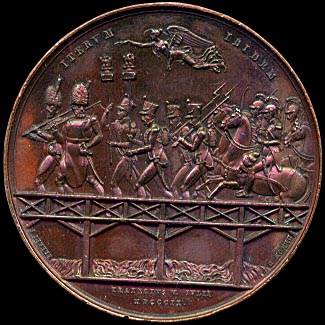
Obverse
Obverse:
Troops passing over a wooden bridge, allegorically representing the army by the various degrees and ranks which are here seen; these are -- two pioneers in front, one of which has the initial x marked on his left arm, two standard bearers, with the French eagle standards, two infantry soldiers and four cavalry, over them hovers the genii of Victory; her right arm is stretched out, as if directing them onwards; in
Legend:
ITERVM IBIDEM. BRENET F. DENON D.
Exergue:
TRAIECTVS V. IULII MDCCCIX.
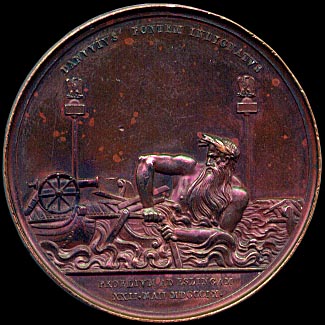
Reverse
Reverse:
a River God, allegorical of the Danube, crowned with sedgy reeds, and an ample flowing beard; he appears half sunk in the curling waves, towing boats across the river; on these are platforms with artillery, and the eagle standard erect. On the right side of the river is seen a wooden bridge, demolished; and on its banks the eagle standard is erected.
Legend:
DANVVIVS PONTEM INDIGNATVS.
Exergue:
PROELIVM AD ESLINGAM XXII. MAII MDCCCIX.

Laskey:

This medal alludes to the destruction of the bridges on the Danube, at the battle of Essling. The Archduke had intended to make a grand effort for the preservation of Vienna, by suddenly crossing the Danube, and hazarding a battle in front of the capital; but the rapid operations of Napoleon having frustrated his design, he took a position near the left bank of the river. The French Emperor had taken his position on the right side of the river, and had fixed his headquarters at Ebersdorff, about six miles below Vienna. Thus the two hostile armies, on the operations of which the fate of Europe was suspended, were posted on the opposite sides of the Danube; and the passage of such a river, in the face of a formidable enemy, must be considered as one of the most difficult and daring enterprises recorded in military history.
  Opposite to Ebersdorff, the headquarters of Napoleon, the Danube divides into three branches, formed by two islands. The distance from the right flank to the first island, which is only about 130 toises in circuit, is about 1000 toises. From this island to the larger, which is named Inder Lobau, and is about six English miles in length, and four and a half in breadth, the distance is 120 toises; in this branch of the river the stream runs with the greatest force. The third branch, which separates Inder Lobau from the left bank, is only seventy toises in breadth (the French toise is about six feet English measure). Napoleon, sensible of the expediency of bringing the contest to a speedy decision, on the 19th of May ordered bridges of pontoons to be constructed over the first two branches. This was speedily effected, and the Emperor having passed over, took possession, on the 20th, of Inder Lobau. He then caused a bridge to be thrown over from that island to the left bank, and this arm of the river requiring only fifteen pontoons, they were fixed in the space of three hours. This being completed, the French began to pass over in the night; and early in the morning, the Emperor, accompanied by the Prince of Neufchatel and the Dukes of Rivoli and Montebello, arriving on the left bank, examined the localities, and determined the position for waiting the impending attack, posting his right at the village of Essling, and his left at that of Gross Aspern, situated at about four miles to the westward.
  On the 21st, the Archduke receiving intelligence from the outposts, that a considerable part of the French army had passed the river, and that the rest were rapidly following, judged the moment to be arrived in which an attack might be made with the greatest hope of success. According to the French accounts, his army consisted of 90,000 men, with 200 pieces of artillery: of the number of the French no positive statement has ever appeared, but it is certain that they had got only a small part of their artillery over the river. At four o'clock in the afternoon, the battle commenced, and at night the victory remained undecided: and the two hostile armies retaining their positions, remained all night under arms, employed in preparations for renewing the combat. During the night, General Oudinot's corps, St. Hilaire's division, two brigades of light cavalry, and the train of artillery, crossed the Danube by the bridges.
  On the 22nd of May, the battle recommenced at four o'clock in the morning; at seven, intelligence was brought to Napoleon, that a sudden swell of the Danube having set afloat a great number of trees which had been cut down near Vienna, the accumulated mass had carried away the bridges thrown over the two first arms of the river. Some of the Austrian accounts say they were destroyed by the means of fire-boats floated down the Danube. All the reserve parks of artillery which were advancing, were, by the loss of the bridges, detained on the right bank, as was also part of the heavy artillery, and the whole of the Duke of Auerstadt's corps. The cartridges for the artillery and infantry being with the reserve park, could not be brought across the river. These circumstances induced Napoleon to put a stop to the movements in advance, and at length retired, in regular order, to their former position in the island of Inder Lobau.
 

Bramsen:

Bramsen - 859
Bataille d'Essling et passage du Danube.
(Brenet.)
DANVVIVS PONTEM INDIGNATVS. Le dieu du Danube détruisant un pont de bateaux. D'un côté, une pièce de canon et une aigle française; de l'autre, un aigle.
Rev: ITERVM IBIDEM. Des troupes traversant un pont. La Victoire, qui plane au-dessus, couronne leurs étendards.
Exergue: PROELIVM AD ESLINGAM XXII. MAII MDCCCIX.
Exergue: TRAIECTVS V. IVLII MDCCCIX.
Médaille, 40 mm. - T. N. 32, 12.

d'Essling:

d'Essling - 1244
Bataille d'Essling et passage du Danube
(Brenet).
Scan of line drawing in d'Essling...
(TN. 32.12 - B. 859). Arg. refr. et br. 41 mm.