Back
Back

France - 1809

Ouverture du canal de l`Ourcq - variant
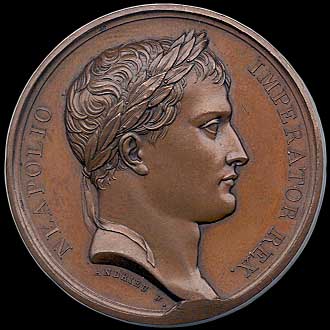
Obverse
Obverse:
Head and legend similar to the preceding;
Exergue:
under the head of the bust, ANDRIEU F.
Size:
40 mm.
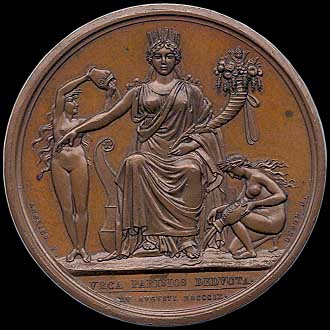
Reverse
Reverse:
Paris, allegorically represented as a female, sitting to the front, on the side of an antique vessel, the prow and rudder appears on each side of her; on her head a turretted crown; her right arm and hand is stretched out, a naked Naid is pouring water over it from an urn, on which is inscribed, URCA; on her left arm, she supports a cornucopia filled with fruit and wheat-ears; another Naid on the left, on one knee, is laving her left foot with water, which she also pours from an urn, on which is inscribed, SEQUANA.
Legend:
ANDRIEU F. DENON D.
Exergue:
VRCA PARISIOS DEDVCTA — XV AUGUSTI MDCCCIX.

Vern's Comments:

Note: this example is a variant, the main difference being the Latin wording of the obverse legend.

Julius - 2122


   All in all a fascinating medal, chock full of history! Laskey informs us (on what authority I don't know) that skating started in Paris after the canal was built; another accomplishment that Napoleon is never given credit for! ;)
   This piece may have been struck in Paris, though the typical chocolate patina does not appear to have been applied. Despite the date both Laskey and Bigi put it in their 1810 lists while Bramsen and d'Essling settle for 1809. No matter when it was made it is quite a nice piece and I've included hi-res photos for those with the bandwidth or the patience.
   The mistake in the date from Bramsen is reproduced from the reference, it doesn't appear on the medal and was probably just a 'typo' though it doesn't show up in the errata page.

Laskey:

   This medal was struck by order of the government of France, commemorating the event of cutting and opening the canal of Ourcq: this canal is upon an elevation considerably above the Seine, and supplies Paris with 972,000 hogsheads of water every twenty-four hours; the length of this canal from its head to Lizy is near twenty-four leagues, and from the level nature of the ground through which it passes, no sluice is required: in its course it receives the springs of Grisette, de May, Terrouane, and Bevronne, and terminates in the great Bason de la Villette; at the same time it is a port for vessels from the Marne, a reservoir for the people of Paris, and a handsome ornament to the Barrier of St. Martin.
 
   The borders of the basin near the Barrier of St. Martin are planted with a double row of trees, forming an agreeable promenade in summer; boats are also used on the smooth and glassy surface of this fine sheet of water; and in winter, when frozen over, it is covered with multitudes of skaiters glancing along on the slippery keel in every direction. Before this fine sheet of water was constructed, the art of skaiting was but little known or practised in the metropolis of France.
 

Bramsen:

Bramsen - 868 (variant)
Ouverture du canal de l'Ourcq.
(Andrieu.)
NAPOLEON EMP. ET ROI. Tête laurée, à droite.
Rev: La ville de Paris assise sur son vaisseau, reçoit sur le bras droit les eaux jaillissantes d'une urne sur laquelle: VRCA, qu'une jeune nymphe élève de toute la hauteur de ses bras, tandis qu'une autre arrose ses pieds des eaux qui sortent de son urne portant l'inscription: SEQVANA.
Exergue: VRCA PARISIOS DEDVCTA — XV AVGVSTI IMDCCCIX.
Médaille, 40 mm. - T. N. 33, 3.

d'Essling:

d'Essling - 2129 (variant)
Ouverture du canal de l'Ourcq, 1809.
(Andrieu.)
Buste lauré de Nap. à dr.
R. La Ville de Paris ass. de face, entre deux nymphes, l'une deb., l'Ourcq, l'autre agenouillée, la Seine.
(TN. 33.3 — B. 868(var.) — Flor. Mess. 420). Arg. 41 mm.

Ouverture du canal de l`Ourcq - variant

obverse

Ouverture du canal de l`Ourcq - variant

Click to dismiss