Back
Back

France - 1803

Le traité d`Amiens rompu et le Hanovre occupé
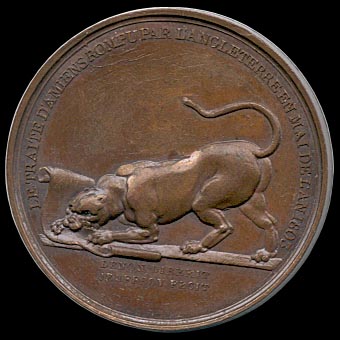
Obverse
Obverse:
An English bull dog in the act of tearing to pieces a scroll, presumed to represent the treaty of Amiens.
Legend:
LE TRAITÉ D' AMIENS ROMPU PAR L'ANGLETERRE EN MAI DE L'AN 1803.
Exergue:
DENON DIREXIT JEUFFROY FECIT.
Size:
40 mm.
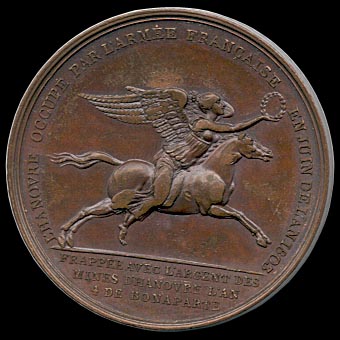
Reverse
Reverse:
>Victory mounted on a horse at full speed, holding out a laurel wreath with her right hand, her left is clasped round the neck of the horse.
Legend:
L 'HANOVRE OCCUPÉ PAR L'ARMÉE FRANÇAISE EN JUIN DE L'AN 1803.
Exergue:
FRAPPÉE AVEC L'ARGENT DES MINES D'HANOVRE L'AN 4 DE BONAPARTE.

Laskey:

The conquest of Hanover by France occasioned this medal to be struck.

After a peace, which only extended to the short space of one year and sixteen days, during which, the greatest jealousy and mistrust pervaded the councils of both the English and the French courts, war was again proclaimed; Malta seems to have been the great bone of contention between both countries, and the French government has endeavoured to throw all the odium of the act on the British, but this is easily set aside by taking a slight review of the transaction itself. At the formation of the definitive treaty at Amiens, we held Malta by conquest. France was unwilling that it should remain with us, and we as unwilling that it should become the property of France. In fact, the arrangements respecting Malta were the only stipulations for which England contended with France during the negotiations: every thing else was a surrender on our part. In order therefore that Malta might be, if possible, independent of both parties, it was agreed that it should remain in the hands of the British for a certain period; after which, it was to be given up to the knights of the order, and to be garrisoned by a Neapolitan force, until the knights should be able to defend it themselves. Now, as the evident spirit, and indeed letter, of this agreement was, that the knights should be independent of any power, we were not obliged to give the island up, until such an event should take place, but Bonaparte himself had rendered that impossible; for, under his influence the property of the order in various parts of Europe was sequestrated; and of course, as he had rendered it impossible that the events which were to happen before we surrendered Malta, could now take place, it naturally followed, that if we were not justified in keeping it, still there existed no reason for giving it up: the failure therefore of the fulfilment of the treaty was on the part of France, not of Great Britain, and Napoleon had no right to avail himself of the error he had committed. Had Malta been given up, it must of course have become the property of France, which would have been in direct opposition to the treaty; so that the calls upon Britain to fulfil the treaty of Amiens, were as futile as they were unjust.

   It appears also from the report of the mission of General Sebastiani to Egypt, that Napoleon had not even yet forgot that country; and no doubt looked on Malta as a half-way house to the same. Sebastiani tells the first Consul, that 6000 men were enough to take all Egypt. The irritation of Bonaparte, at seeing himself thus foiled, therefore, cannot be wondered at, and in an unguarded moment he harshly expressed himself to our ambassador (Lord Whitworth) at his court, saying he would rather see the English in possession of the Faux-bourg St. Antoine, than they should retain Malta.
   On the 16th May, his Britannic Majesty sent a message to both houses of parliament, that he had recalled his ambassador from Paris, and that the French ambassador had left London. Both nations now began to develope their means of attack; Malta the cause of the war, was so strong and well garrisoned, that France could have had no hope of wresting it from us by any force she could then bring against it: Great Britain would of course direct her efforts against the maritime possessions of France, while the latter powerful by land, would obstruct her commerce on the continent.
   General Mortier now summoned the Hanoverian electorate to surrender to his army; but it is plain that Bonaparte wished to leave an opening for peace, as General Mortier stated he only wished to occupy the country as a pledge for Malta, according to the treaty of Amiens, and he had done this only to make the king of England maintain that treaty. The duke of Cambridge was sent over to Hanover, as commander-in chief, and he published proclamations calling on all that were able to bear arms to defend their country, yet the people were too cautious; in vain the duke told them he was ready to share their dangers; they rather seemed to listen to General Mortier, who advised them to be careful and not make themselves the victims; to this the Hanoverians paid attention, and would not oppose the French. The military made some trifling opposition, which was of no use, and they were forced to capitulate and engage not to serve against France or her allies till regularly exchanged.
   On this occasion, Austria and Prussia were content merely to demand an explanation; when Napoleon answered, that Hanover had nothing to do with the Germanic Empire, nor Germany with it; that it was solely the possessions of the king of England which were attacked, but that in other points the integrity and independence of the Germanic Empire should be respected.
   In one of the exposés now ushered forth to the world, was one of congratulation to the people of France; wherein he states, that by the occupation of Hanover, he has been enabled to remount and equip the French cavalry at the expense of the king of Great Britain, and by that possession which, of all others, he considered as the dearest to that monarch.
 
   N. B.- There is another medal struck on this occasion, bearing on the obverse, the head of Bonaparte with a laurel wreath encircling his head. Legend, NEAPOLIO IMP. REX. Exergue, J. P. DROZ. F. Reverse similar to the preceding medal.
 

Bramsen:

Bramsen - 271
Le traité d'Amiens rompu et le Hanovre occupé
(Jeuffroy.)
LE TRAITÉ D' AMIENS ROMPU PAR L'ANGLETERRE EN MAI DE L'AN 1803. Le léopard anglais déchirant un papier déroulé. Rev: L 'HANOVRE OCCUPÉ PAR L'ARMÉE FRANÇAISE EN JUIN DE L'AN 1803. La Victoire ailée, à cheval, en pleine course à droite.
Exergue: FRAPPÉE AVEC L'ARGENT DES MINES D'HANOVRE L'AN 4 DE BONAPARTE.
Médaille, 40 mm. - T. N. 94, 7; H. m. 30, 69; M. F. 344, 143.

d'Essling:

d'Essling - 995
Le traité d'Amiens rompu, le Hanovre occupé
(Jeuffroy).
Léopard anglais déchirant le traité. R. Victoire montée sur un cheval galopant; à l'ex: FRAPPÉE AVEC L'ARGENT DES MINES D'HANOVRE, etc.
(TN. 94.7 - M. 69 - B. 271) Arg. et Br. 40 mm.

Le traité d`Amiens rompu et le Hanovre occupé

obverse

Le traité d`Amiens rompu et le Hanovre occupé

Click to dismiss