Back
Back

France - 1796

Bataille de Castiglione
Obverse
Obverse:
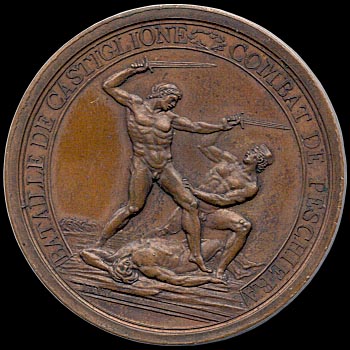
On the field of this medal, are represented three naked Combatants, one of which lies dead on the ground, over the body of which the other two are in close combat.
Legend:
BATAILLE DE CASTIGLIONE, COMBAT DE PESCHIERA.
Exergue:
name of the artist, LAVY
Size:
43 mm.
Reverse
Reverse:
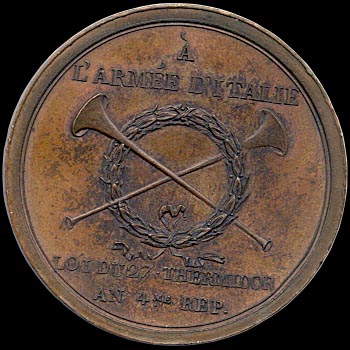
A laurel wreath, with two antique trumpets saltier;
Legend:
on the field, A L'ARMEE D'ITALIE:
Exergue:
LOI DU 27 THERMIDOR, AN 4ME. REP.

Vern's Comments:

 
Fortiter had an interesting essay on the Five Battles that the medals struck in Italy were edge marked BONAPARTE GENERAL EN CHEF and that the dies were later taken to Paris where the edge markings were not done. Apparently some of the examples struck in Milan were also plain-edged and this piece would seem to possibly be one of those. Although plain-edged it also lacks the characteristic chocolate brown patina of a Paris strike. If you translate the excerpt from Hennin below you will see that it was recognized at that time (1827) that there were two variants of Italian strikes. Captain Laskey makes no mention above of the edge at all; indicating he was probably describing a plain-edged Paris strike.
 

Laskey:

   The accounts of the Battle of Castiglione, which we have met with states, that the successes of Wurmser, who had succeeded General Beaulieu, had placed the French armies in a very delicate situation. On the 1st August, the army advanced, while the Austrians detached a force to Castiglione, where General Valette had been left with 1800 men to defend that important post, and to keep the division of Wurmser at a distance; but Valette was completely defeated, and escaped with only half his troops to Monte Chiaro. Bonaparte, vexed by the issue of this affair, instantly suspended General Valette.
   The two armies faced each other on the morning of the third, the Imperialists, not waiting the attack of the French, surrounded the advanced guard of General Massena, near Castiglione, and took General Pigeon prisoner, with three pieces of flying artillery. The French had hopes of penetrating the Austrian line, and the latter extended it, in order to surround the French; the Imperialists were thrown into disorder, and retreated to Salo; but, that place being then in the hands of the French, they wandered through the mountains, and many of them were taken. Meantime, General Augereau took Castiglione, and, during the day, maintained several obstinate actions with the enemy, who fought with great bravery and courage.
   Bonaparte, being satisfied of the destruction of all the hostile corps from Gavardo and Salo, on the 5th August, ordered the whole army to make a retrograde movement.

Hennin:

No. 743. Pl. 74. 6 Août 1796. Médaille.
Bataille de Castiglione, etc.
R. A l'armée d'Italie. Tranche lisse (frappée à Milan).
Avers du même coin que la médaille précédente.
Revers du même coin que la médaille précédente. La tranche est lisse. Les épreuves de cette pièce sont en cuivre rouge; et plus minces que les épreuves de celle décrite au numéro suivant [43m].
Scan from Hennin's plates...
   Voyez l'article de la médaille précédente.
   Cette pièce est la même que la précédente, également frappée à Milan, mais avec la tranche lisse.

d'Essling:

d'Essling - 690
Bataille de Castiglione, combat de Peschiera
(Lavy)
Guerrier combattant deux ennemis. R. Trompettes en sautoir brochant sur une couronne de laurier.
(TN. 61.3 - H. 744 - M. 4) Arg. et br. 43 mm.

Bataille de Castiglione

obverse

Bataille de Castiglione

Click to dismiss