Back
Back

France - 1805

Venice rendue à l`Italie - Brenet
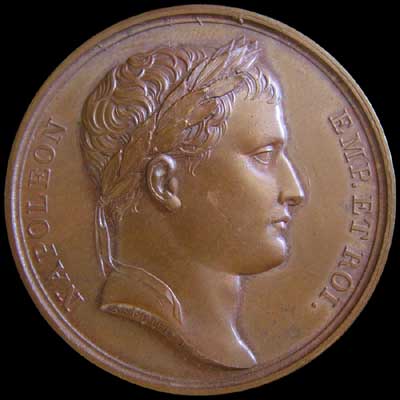
Obverse
Obverse:
Head of Napoleon encircled with a laurel wreath.
Legend:
NAPOLEON EMP. ET ROI.
Exergue:
On the base of the head, ANDRIEU F.
Size:
41 mm.
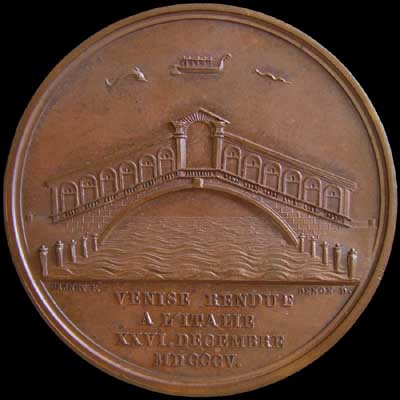
Reverse
Reverse:
The Rialto Bridge at Venice. Above the bridge, on the upper part of the field of the medal, a small Gondola, a Dolphin, and a Hydrus or Water Serpent, emblematic of the Adriatic sea, and the numerous canals intersecting Venice.
Exergue:
VENICE RENDUE A L'ITALIE XXVI. DECEMBRE MDCCCV. BRENET F. DENON D.

Vern's Comments:

Millin:


115. Planche XXXV. Obverse. Same as No. 103.
Reverse. Bridge of Rialto at Venice; above, a Gondola and two fishes. Exergue. VENISE RENDUE A L'ITALIE, XXVI DECEMBRE MDCCCV. BRENET F. DENON D. (P.M.)
   By the treaty of Presbourg, the city of Venice was ceded to the kingdom of Italy.

Laskey:

   At Leoben, to induce Austria to treat for peace without the intervention of Great Britain, Bonaparte then offered her the possession of the Venetian dominions as an equivalent for the Netherlands, which Bonaparte had wrested from her; this she eagerly accepted, tempted by the hopes of thereby becoming a commercial, perhaps a naval power, in consequence of this accession of maritime territory.
 
   It will therefore appear, whilst Napoleon was signing the peace of Leoben, that he was actually engaged in planning the destruction of Venice, one of the most ancient republics in the world, and Augereau was fixed on to carry this into effect. To bring about some excuse for this premeditated attack, a few inhabitants of the Venetian terra-firma, seduced by French emissaries, and no doubt irritated by French oppression, had been reduced to oppose resistance to the marauding parties of republican troops then desolating their hitherto peaceable homes: the opposition, however, soon became more formidable, and 40,000 peasants were not only in arms, but might also have cut off the retreat of the whole French army from Carinthia, if it had not been for the unfortunate treaty just concluded.
 
   At this period, General Augereau commanded that part of the army between the Piave and the Adige; and as he was not in sufficient force openly to oppose the insurrection which was making considerable progress, he found it necessary to publish a most deceitful proclamation, promising redress for all grievances, and offering general amnesty and oblivion with respect to hostilities.
 
   He partly succeeded in his intentions, which were merely intended to gain time, to suspend the activity of the insurgents, and also to divide their opinions until Bonaparte himself should arrive; nor was he disappointed, for Bonaparte having collected a part of his army, early in May, immediately published a declaration of war against Venice; and without the slightest resistance, he instantly took possession of the Venetian dominions upon the main land, permitting his troops to live there, for some time, uncontroled. Augereau was now ordered to march a column of 25,000 men to the sea-coast, opposite to the numerous islands on which the city of Venice is situated; and though its natural defences would have served to defend it against an attack, yet there, as in other places, he had by plots and intrigues paved the way, by dividing the people, that no resistance was offered; and Augereau took possession of the city on the 12th of May.
 
   In furtherance of Napoleon's plans, his first object was to seize the arsenal, and to occupy the military works; after which he established a municipality, imprisoning and shooting several of the most eminent nobles of the state, plundering private property as well as the public establishments. In this system of plunder he was greatly assisted by the savans, who always accompanied his army; but so extensive was the city, and so great its wealth, that it took him eight weeks to complete its destruction. This Bonaparte denominated "The regeneration of Venice."
 
   Amongst other things which Napoleon took from the state, were six ships of the line completely equipped; forty paintings, to be chosen by his savans or commissioners; the most precious monuments of the library of St. Mark; the four famous horses, said to have been the work of Lysippus, and the two lions of gilt bronze, which had been brought from Constantinople; all of which were packed up, and sent off to ornament the National Museum and the city of Paris.
 

Bramsen:

Bramsen - 460
Venice rendue à l'Italie.
(Brenet.)
NAPOLEON EMP. ET ROI. Tête laurée, à droite.
Rev: Vue du pont du Rialto sur le grand canal à Venice.
Exergue: Venice RENDUE A L'ITALIE XXVI. DÉCEMBRE MDCCCV.
Médaille, 40 mm. - T. N. 10, 7; H. m. 35, 115; M. F. 358, 41.

d'Essling:

d'Essling - 1115
Venice rendue à l'Italie
(Droz, Andrieu et Brenet).
Tête de Nap. à dr.
R. Vue du pont du Rialto
(TN. 10.7 - M. 115 - B. 460 - Flor. Mess. 323). Arg. et br. 41 mm.

Milan:

516/518. NAPOLEONE- Venezia -Annessione al Regno d'Italia
D. NAPOLEON EMP•ET ROI•
Nel centro. testa laureata di Napoleone a s.; nel campo, in basso, nel taglio del collo: DROZ FECIT e sotto: DENON DIREXI / M•DCCCVI• Contorno a piatto e gola perlinato.
R. VENISE RENDUE / A L'ITALIE / XXVI•DÉCEMBRE / MDCCCV• (all'esergo)
Nel campo. al centro. veduta frontale del Ponte di Rialto sul Canal Grande; in alto, delfino, bucintoro(?) e serpente: in basso. sotto il taglio dell'esergo, a s.: BRENET F, ed a d.: DENON F• Contorno a piatto e gola.
 
Autore: DRoZ / BRESET Data: 1805
Caratteristiche tecniche: Bronzo; Ømm 41; 0; Coniazione
Condizione giuridica: Stato-Brera n. 199; N. Inv.: M.0.9.30373
Bibl.: Bramsen. n. 460 (R.); Julius, nn. 1471-1472 (R.); Essling. n. 1115; Millin n. 110; De Félissent, nn. 344-345
Accoppiamento ibrido(?) con un D. datato all'anno successivo. 1806.

Venice rendue à l`Italie - Brenet

obverse

Venice rendue à l`Italie - Brenet

Click to dismiss