Back
Back

France - 1806

Confédération du Rhin
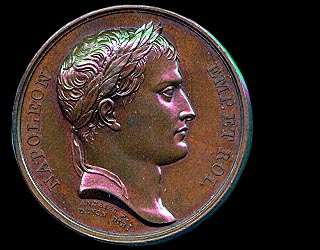
Obverse
Obverse:
Head of Napoleon, encircled with a laurel wreath.
Legend:
NAPOLEON EMP. ET ROI. E, ANDRIEU F. DENON DIRT.
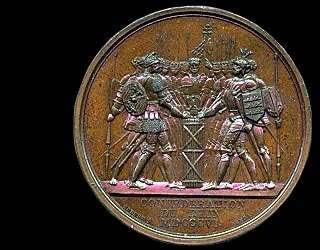
Reverse
Reverse:
a group of warriors armed with spear and shield, swearing fidelity to each other, and to the cause in which they are engaged; the shields of those in front have their arms emblazoned on them; in the centre of the group is seen Cardinal Fesch, he being nominated primate of the confederation, with his Cardinal's hat, cross, &c.; they are arranged around a fasces, the centre of which is the eagle standard of France.
Exergue:
CONFÉDÉRATION DU RHIN MDCCCVI. BRENET F. DENON D.

Laskey:

The fatal battle of Austerlitz, as we have before observed, put an end to the greatness of Austria, and virtually subverted the substance of the Germanic Constitution; its form was not suffered long to remain. The Emperor Napoleon having determined that that there should not exist on the continent, any power that might be capable of opposing his designs, artfully contrived to dismember the German Empire, dissolve the Germanic union, and induce the Emperor to resign his office and dignity, which ever since the days of Charles the Great or Charlemagne, had been preserved inviolate amidst the revolutions of kingdoms and states, and the general convulsions of Europe.
 
In pursuance of these views, a new sort of union was formed among several of the German Princes, under the name of the confederation of the Rhine. The kings of Bavaria and Wirtemberg, the Arch-Chancellor, the Elector of Baden, the Duke of Berg, the Landgrave of Hesse Darmstadt, the Princes of Nassau Weilbourg, and Nassau Usingen, of Hohenzollern, Hechingen, Siegmaringen, Salm-Salm, Salm-Kyrburg, Isenburg, Birstein, and Lichtenstein, the Duke of Aremberg, and the Count of Leyen, published at Ratisbon, a declaration purporting, that as the Germanic Constitution then existing, could afford no guarantee to the public tranquillity, the contracting parties had agreed, that their states should be for ever separated from the Germanic body, and united by a particular confederation, under the title of "The Confederate States," of which the Emperor of the French was constituted the head and protector. This treaty of confederation was projected and drawn up at Paris, and ratified at Munich, on the 25th July, 1806: it consisted of forty articles relative to the territories which each of the contracting powers were to possess, and other important particulars. Every continental war in which either France or any of the confederates should be engaged was to be common to all; the contingent to be furnished by each of the members, was determined in the following proportion; France 200,000 men, Bavaria 30,000, Wirtemberg 12,000, Baden 8,000, Berg 5,000, Darmstadt 4,000, Nassau and the other states 4,000. The king of Bavaria bound himself to fortify Augsburg and Lindau, and to form and maintain in the first of these places, artillery establishments, and in the latter a depot of small arms and ammunition sufficient for a reserve: he also engaged to institute at Augsburg, a baking establishment sufficient for the immediate supply of the armies in the event of a war. The contingent of the allies was subdivided into four parts, and the assembly was to decide how many of those should be called into action, in the event of any foreign or neighbouring power creating alarm by its warlike preparations; but the armament was to take place only on the summons of the Emperor of the French, as the head and protector of the confederation. The city of Frankfort was fixed on for the meeting of the general assembly of the confederates; and the union was to admit of the accession of the other German princes and states, whenever it should be consistent with the general interest.
 
By this confederation the Germanic body was completely dissolved, and a very considerable part of its members ranged themselves under the banners of France. The Emperor, Francis II., in consequence of this disorganization, resigned his high office of Emperor of Germany, and took that alone of Emperor of Austria.
 
Thus was dissolved the German, or as it was styled in diplomatic language, the holy Roman Empire; 1006 years after Charlemagne received the imperial title and crown from the hands of the Pope at Rome.
 

Bramsen:

Bramsen - 534
Confédération du Rhin.
(Brenet.)
NAPOLEON EMP. ET ROI. Buste lauré, à droite. Rev: Sans légende. Quatorze princes allemands, revêtus de l'ancienne armure nationale, sont groupés autour d'un faisceau, sur lequel ils ont posé les mains pour prêter serment. Au fond le Prince-primat avec les emblèmes de sa dignité ecclésiastique.
Exergue: CONFEDERATION DU RHIN. MDCCCVI.
Médaille, 41 mm. - T. N. 14, 4; H. m. 40, 201; M. F. 362, 58.

d'Essling:

d'Essling - 1139
Confédération du Rhin.
(Brenet).
Buste lauré de Nap. à dr. R. Quatorze princes allemands prêtant serment sur un faisceau.
(TN. 14.4 - M. 201 - B. 534) Arg. et br. 41 mm.