Back
Back

France - 1805

Prise de Vienne et de Presbourg
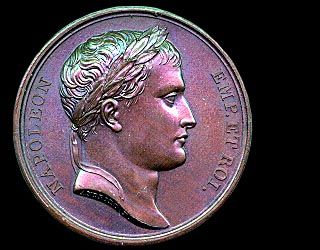
Obverse
Obverse:
similar to the preceding.
Size:
41 mm.
Reverse
Reverse:
Napoleon standing full to the front, in the character of Hercules, in a state of repose, resting on his club, his head laureated, and the lion's skin over his shoulder, which falls behind; on each side, on their knees, two females draped, the Genii of the cities of Vienna and Presbourg, are presenting the keys of their respective cities to the conqueror; their heads are turretted and veiled.
Exergue:
PRISE DE VIENNE ET DE PRESBOURG MDCCCV. DENON D. GALLE F.

Laskey:

After the capture of Ulm, the Austrians and Russians, finding themselves unable to make any opposition, retreated towards Vienna; all the citizens capable of bearing arms, were embodied, and a proclamation issued, in which the Emperor of Austria "trusted in the justice of his cause, and in the love and energy of 25 millions of people aided by his Russian auxiliaries."

 
Napoleon arrived at Brannau on the 30th; this was a place of great strength, with magazines of artillery, powder, and military stores; which proved a seasonable supply to the French army.
 
Murat with his cavalry attacked the Austrian rear-guard, charged them, and forced them to give way: they rallied, but after an obstinate conflict were put to flight with great loss. The different generals of division took other places from the Austrians, whom they drove before them. Napoleon made arrangements for forcing the enemy from the Ems, being the last line of defence which remained between that river and Vienna, towards which place the Austrians slowly retired; the French army crossed this river, and eagerly pressed forward towards the Austrian capital, which at this time was in a state of great confusion, and their only hopes rested upon a Russian division of the allied army, which had taken a position on the heights of Amstettin, where a most tremendous conflict ensued, in consequence of thier being attacked not only by the cavalry under Murat, by also by the grenediers of the French corps, all of whom were now in advance, and formed a strong body under the command of Oudinot. The Russians, after a gallant resistance were obliged to retire, and they marched slowly upon a strong position not more than ten leagues from the capital, called St. Polten, having first destroyed the bridges over the river Ips, which gave a temporary check to their pursuers.
 
The Austrian cabinet, alarmed at Napoleon's rapid advance, his head-quarters on the 7th November being at Lintz, instantly dispatched the Count Guilay in the name of the Emperor, and of the Russian commander-in-chief to request an armistice, in order that such a measure might prepare the way for preliminary negotiations leading to a general pacification.
 
Napoleon expressed the greatest readiness to grant the armistice; but then this was upon conditions as humiliating to Austria as if he had already been in possession of the capital. The envoy returned with a heavy heart, and Napoleon made not the slightest alteration in his military objects.
 
All the troops which the Emperor of Germany could now collect were ordered to push forward for the defence of the capital, and General Meerfeldt with considerable force was advancing on the side of Neustadt; but whilst a few miles from Meminzel, he was attacked by Davoust's corps on the 8th November; when an obstinate and bloody action took place, ending in the total defeat of the Austrians. After this affair, Davoust pushed on for Vienna with every facility, being now in the great road for that capital.
 
On the 9th November, the Russians finding the position of St. Polten no longer tenable, they determined to cross the Danube, which manoeuvre they put in execution, destroying the bridge of Krems as soon as they had passed over.
 
Napoleon now advanced to Murat's head-quarters at Moelk, from whence his road to Vienna was open; and there he received a deputation of the citizens of Vienna, who humbly prayed that he would treat their unfortunate city with lenity, as they were not the cause of the war. The only answer they received was, they must open their gates only to the French army.
 
The Austrian Emperor now found it expedient to retire from a defenceless city to Brunn in Moravia, and the French took possession of the city without firing a shot. The main body of the French arrived at Vienna on the 12th, and were lodged in the suburbs, they entered the city on the 13th, when they found the inhabitants doing the duty of the military, who had totally evacuated it.
 
Bonaparte entered Vienna on the 14th, and chose the imperial palace of Schoenbrunn for his residence.
 
Immediately after the capture of the Austrian capital, the corps of Davoust was detached towards Presburg, which it took possession of, and from which place Davoust commenced a negotiation with the Archduke Palatine, the object of which was to free Napoleon from part of his opponents, by establishing the neutrality of Hungary.
 

Bramsen:

Bramsen - 443
Prise de Vienne.
(Galle.)
NAPOLEON EMP. ET ROI. Tête laurée, à droite.
Rev: Napoléon debout en Hercule, à ses pieds deux femmes tourellées lui présentent chacune une clef.
Exergue: PRISE DE VIENNE ET DE PRESBOURG MDCCCV.
Médaille, 40 mm. - T. N. 9, 7; H. m. 34, 106; M. F. 355, 35.

d'Essling:

d'Essling - 1101
Prise de Vienne et de Presbourg.
(Andrieu et Galle).
Tête laurée de Nap. à dr.
R. L'Empereur en Hercule deb. de face. A ses pieds les deux villes agenouillées.
(TN. 9.7 - M. 106 - B. 443) Arg. et br. 41 mm.