Back
Back

France - 1789

Arrivée du Roi à Paris.
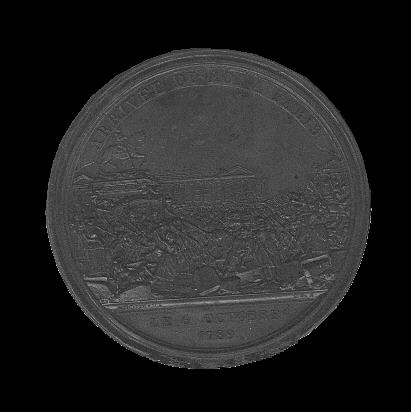
Obverse
Obverse:
The carriage of Louis XVI and his family arrives in Paris, effectively completing the Revolution by removing his freedom of movement.
Legend:
ARRIVEE DU ROI A PARIS
Exergue:
LE 6 OCTOBRE 1789
Size:
82 mm.

Vern's Comments:

This piece is huge, 3 1/4" across, uniface struck in lead and apparently coated with the brown patina mentioned in David Block's short essay on the subject.

The dealer's notes read in part "Not a 1789 original but most unlikely it would have been produced after 1820."  I remember the dealer telling me that his research indicated a likely strike around 1810 but he had no substantiation for that speculation.


It's worth clicking to see the enlargement. You can clearly see the King's carriage in the center left, the throngs of people. Notice the little touches, the man with his arm around his girls' waist on the far left, the statue, probably of Henri IV, the last good Bourbon king, behind the carriage. There's a little boy on a man's shoulders on the far right, people are climbing the rocks in the foreground to get a better view. Just to the left of the woman with her arm raised there looks to be a couple of guys fighting. It looks like the aristocrat got popped in the nose and ended up on his backside. (Aristocrats can be identified by the tall hats). The two guys in the right center foreground are just standing around with their hands in their pockets watching the show.

Again, this piece measures 2mm larger than Hennin describes.

Hennin:

No. 62. Pl. 8.
6 Octobre 1789.
Cliché
Arrivée du Roi à Paris. Le 6 octobre 1789. Deuxième état du coin.
R. Sans revers.
ARRIVÉE DU ROI A PARIS. Louis XVI, en voiture avec sa famille, et entouré du peuple qui le conduit de Versailles à Paris, passant sur la place de Louis XV. Exergue: LE 6 OCTOBRE 1789. Au-dessus de l'exergue, entre deux lignes: ANDRIEU F. - NO. 2 (Andrieu fecit. - No. 2)
Sans revers [80m.]. Étain.
   Cette pièce est la même que la précédente, avec les nouvelles légendes que Bertrand Andrieu substitua à celles qu'il avait d'abord gravées sur le coin, ainsi qu'on l'a vu à l'article du numéro précédent. Cette pièce-ci, après la retouche, constitue la seconde variété ou le second état du coin. On peut remarquer, à l'appui de ce détail, que la partie sur laquelle est placée la légende, dans cette pièce-ci, est plus saillante que dans la première variété; ce qui vient de ce qu'il avait fallu enlever la place de la première légende afin de graver la légende substituée.

Arrivée du Roi à Paris.

obverse